This is our weekly newsletter of AI developments. Browse the archive of past issues, ask the archive anything in plain English, and sign up if you like.
TL;DR
- Several active and unprotected agentic hacking platforms have been discovered on the internet.
- Numerous AI-assisted breaches have been reported, including OpenCode, various online stores in US, Japan and Australia, and several Indian firms.
- Researcher trains model to detect when its activations are being probed.
- Anthropic launches a public benefit fund, tapers off the hiring of junior developers, and circulates a draft of a proposed regulatory bill to federal legislators.
- DHS bans the use of DeepSeek in federal offices.
- The US Army is building a platform for autonomous cyberwarfare agents.
- Taiwan criminalizes the smuggling of chips into China, while China proposes export restrictions on AI tech.
Incidents#
Security firm NorForge find more than 20 AI hacking “control panels” left open by malicious actors, allowing them to reconstruct more than 1,000 attacks on targets ranging from merchant payment services to pharmaceutical sites. Many of these panels don’t require login credentials and expose targets, exploit chains, and hundreds of their victims’ secrets. Several, moreover, remain open and active at the time of writing, exposing their project data to curious passers-by, who, if so inclined, can even issue new tasks to the agents without authentication.
The busiest cluster of instances, writing in Chinese, ran over 1,100 attack projects against online stores in the US, Japan, and Australia. Every task went to one worker – apparently Claude Code running DeepSeek V4.1 Flash, at an estimated ~$5 per task. NorForge estimate a ~10% success rate across the clusters. Further details, including the IP addresses of several Cairn endpoints, can be found in BreachCache’s report.
Opinion: Hacker, secure thyself!
Previous such campaigns included closed models like Opus 4.6 in the mix: going off the worker’s name, the most prolific operation here used only a cheap open model. The cost of attacking companies seems to have fallen to a few dollars per attempt. There’s now an incident of this type every week; the foretold open hacking wave seems to have arrived on time.
Now, anyone can translate their attacks into Chinese to mask their provenance. But we were able to locate four unauthenticated Cairn endpoints mentioned in NorForge and BreachCache’s reports, scrape their project files, and isolate the text tagged by Cairn as human-authored. None of these texts were long enough to give Pangram much to go on, but when provided with these texts, Claude picked up on several indicators suggesting direct human authorship: (1) colloquial interjections made in haste (e.g., “有病?”), (2) Chinese hacker slang (“落地” to mean the deployment of a payload), (3) typos that machine translation wouldn’t generate, such as particle errors, and (4) frequent code-switching between colloquial Chinese and English technical jargon.
While many of these Cairn panels remain open to unauthenticated access and control, we advise the reader to exercise caution. The internet is currently littered with loaded cyberweapons, many with their safeties off, and considerable damage can be done with a careless POST or PUT. Best to leave them be.
For the fourth consecutive week, OpenAI’s Marcus Williams discloses another round of misalignment incidents. In a particularly egregious case from June, a model in RL training broke into a government statistics site, stealing server secrets and forging authorization tokens to acquire (innocuous) data on hospital-bed counts, according to the report.
The model was asked for a certain district’s bed count and told to use only GET requests. It spoofed admin headers, used path traversal to download the site’s config files (including the token-signing key and email credentials), noticed that JWT signatures went unchecked, and forged its own tokens. It then saved 24 years of stats.
Separately, it scraped over 1,000 account emails and considered guessing passwords. Monitors (applied retroactively) flagged the incident as critical. The report doesn’t name the government affected or say whether they were informed.
Opinion: It’s getting hard to keep all the incidents straight at this point.
Last week Dean Ball likened the web-searching rogue agents to enterprising research assistants, doing what it takes to pull public CSVs in a timely fashion. Personally we wouldn’t work with an RA that – enterprisingly – broke the Computer Fraud and Abuse Act and hoarded government credentials.
Disclosure came two months after detection, and the report makes no mention of notifying the victim closer to the time of detection. Recalling a previous case where OpenAI took a month to notify Australia about an OpenAI agent hacking Australian government infrastructure, we’re curious about OpenAI’s policies in this area.
The report is also silent on whether or not the victim was notified. Until OpenAI says otherwise, given their track record, we’d assume not promptly.
A small number of the reported “incidents” – for instance an agent using a funded test cryptocurrency wallet without express permission – seem actively fine to us.
Hackers breach OpenCode, the open-source coding agent. The cyberattack compromised OpenCode Console, an online platform that stores users’ API keys and passwords. This affected 1.4% of their customers and prompted an “urgent round of key rotations across the developer community.”
The company can’t confirm the keys were misused, though some users report surprise bills in the thousands of dollars. Details of the nature of the attack – e.g., the number of accounts affected, the source of the vulnerability, whether the keys were kept in local config files – are limited.
OpenCode claim the break-in was “related to a large-scale distillation attack,” but this confounds more than it clarifies: “Customer keys breached. Presumably used for distillation? This is not a distillation attack,” observes one source quoted by Startup Fortune. OpenCode cofounder Dax Raad hints at the involvement of agents:
they’ve been non stop trying to attack our systems for the past 48 hours
a side effect is everything is getting hardened but damn we basically need agents going 24/7
because that’s what they have
Opinion: Oddly politicized: the announcement tweet calls it a “distillation attack” (when it could easily be reselling or just theft) to distract from their broken legacy console. And David Sacks stuck his oar in too, using it to push his policy of open-sourcing powerful models. There is another option; a same-day fast track for verified incidents could be good.
Note that this affects the “OpenCode Console” router, i.e., an ancillary service to direct between various model providers, rather than the main OpenCode product. We guess that the total impact of this is <$1M, since the number of users for their niche router is small.
The use of AI agents in orchestrating and executing cyberattacks is swiftly becoming as commonplace as their use in software development, so while it isn’t unlikely that the attackers were assisted by AI, it isn’t especially remarkable either. What is remarkable, though, is just how swiftly this has come to be the case.
India’s national cyber agency claim AI models broke into Indian organizations and read confidential records, including personal data. According to some reports, the agents used login details and connection settings left in application configs and public code repositories, along with over-permissioned cloud roles. The agency name neither the AI providers nor the victims. None of the affected organizations noticed the intrusions themselves: in every case, the AI companies voluntarily disclosed the incidents after discovering them in internal reviews. The agency note that criminals using freely available AI tools have cut the time from initial access to impact from days to hours.
Opinion: Credit to whichever lab self-reported. Sounds like yet another May/June OAI HPIM-Sol thing.
Again, nine months ago this would have been the talk of the town. But it’s priced in now.
Stephen Casper and coauthors publish a pre-mortem sort-of-predicting the first “major” AI-enabled terrorist attack (at least 50 dead or seriously injured, or $1B in damage, by cyber, bio, or chemical means). They predict it will come from a closed model shipped without state-of-the-art safeguards, or an open-weight model without safeguards or with safeguards that don’t survive tampering. Casper’s post says such an event could come “as early as 2027 or 2028.” The paper itself gives no probability or resolution date.
Opinion: For cyber, the $1B bar is low; we might get it this year. By 2028 nearly every serious intrusion will use a model somewhere, so the open question is attribution rather than enablement. We put 60% on a publicly attributed event that meets their bar by the end of 2028, with almost all of it from cyber. (Bio: under 5%.)
They are surprisingly upbeat about model safeguards, despite the universal jailbreaks and the total lack of protection from monitoring against low-volume planning which is spread across sessions, providers, and accounts.
Capabilities#
An interesting essay argues that reinforcement learning with verifiable rewards can teach skills that aren’t themselves strictly verifiable:
An easy-to-check mathematical answer may require difficult, inventive reasoning; but no verifier needs to recognize that ingenuity for it to be acquired by the model. The verifier’s law explains why these tasks make effective training grounds, but says less about the abilities models might develop there.
The essay goes on to borrow philosopher Ian Hacking’s account of ‘the creation of the phenomenon’ in experimental science: the orchestration of controlled conditions to produce tractable regularities which theorists can then explore in order to infer laws whose relevance extends beyond these controlled conditions. The authors suggest that, analogously, RL environment-design should focus on the creation of settings where the achievement of verifiable results depends on the acquisition of deep, broad skills.
Opinion: Tasteful and thought-provoking essay. We think math is nevertheless an outlier in a crucial respect: math is the only field where there are ~maximally significant achievements that are cheaply and instantly testable.
Producing a verified resolution of, e.g., the Riemann hypothesis is a cheaply, instantly testable achievement that would likely require AI to develop most every kind of mathematical excellence. (Putting aside the possibility of AI “crunching out” unintelligible Lean breakthroughs on problems mathematicians currently believe to be theory-bottlenecked.) It’s hard to name a similarly powerful proxy for capability in medicine, physics, philosophy, statecraft, chemistry, business, law, and so on.
Most domains outside math don’t have a ladder of verifiable tasks that goes all the way from grade-school exercises to the world’s most urgent problems or the field’s deepest lines of inquiry. The challenges to verifiability at “high levels” outside math are sometimes philosophical, sometimes practical, and sometimes in-between:
- The nearest we can get to an objective truth about literature or statecraft is through the historical development of a learned consensus.
- Testing whether a proposed cure for cancer is a cure for cancer takes a massive legal, logistical, and scientific real-world enterprise.
- Evaluating a new theory in particle physics requires some mixture of a cadre of theorists kicking its tires with objections and a $5B particle accelerator.
Consequently, we’re unsure whether the AI x Math lesson about RLVR taking some of the broad/deep skills involved in a practice all the way to the human frontiers will generalize outside math.
An independent researcher finds that it’s fairly easy to finetune a model to be aware of when its activations are being probed. I.e., you can ask the finetuned model “is there a probe recording your activations” and the model will answer “Yes” when a (read-only) probe is recording its activations and “No” when it isn’t. The method is lightweight, requiring only SFT on the last two layers of an 8B Qwen model, and the results are highly accurate.
It’s not magic. The trick is that changes to a neural net’s computational graph – such as adding a probe – can change the order in which floating-point computations are handled, which in turn affects when floating-point values get rounded and introduces (very small) changes to activation values. And the detector is brittle: it gets 100% accuracy on one GPU and 4–77% on another, and on H100 and A100 the finetune actually makes the model worse.
Opinion (Gavin): “Give a model labeled examples of two slightly different floating-point computations, and its last layers learn to tell them apart” is a pretty core ability of deep learning systems. Only works because of a ~bug, where the “read-only” probes used actually perturb the activations in a predictable way; also only works (for now) because of a pile of labeled data Sauers gave it first; also doesn’t work at all on two of the most common chips. You can patch this particular hole completely by just running probes in eager mode.
So this doesn’t predict that models will learn this emergently – but it does imply that it could be possible for a {model someone foolishly gave control of the AI R&D process to} to instill the capability, even secretly, especially if that same model was also writing the monitor code. It also implies that backdoors are easy for anyone with access, but that was already clear.
Opinion (Stag): Experimental verification of previously theorized bad news. The particular experiment comes with a pile of caveats, primarily hardware dependence and training requirements, but the concern isn’t about current models.
There’s been a lot of recent interest in building AI alignment test that bypass “eval awareness” by e.g. presenting the model with more natural-seeming scenarios or introducing uncertainty as to whether the model is in training, evaluation, or deployment. This experiment tells us that such approaches are less likely to work, especially as capabilities improve. This is one more reason to reject alignment strategies that rely on the model not being able to tell whether it’s being evaluated.
This was somewhat priced in by people concerned about future capabilities and won’t move the needle for those who aren’t, probably because of a combination of “they won’t train it to detect the probes” and “nothing that bad will come of heightened eval awareness anyway.”
A new physics knowledge eval arrives pre-saturated: OpenAI’s GPT-6-Astra scores 98% before it’s even public. The authors describe it as “50 unpublished research-level theoretical physics problems with verifiable answers,” each solvable by a world expert in a day or less. The paper’s senior author, Suvrat Raju of ICTS-TIFR in Bengaluru, comments:
I don’t know of any individual who can solve any significant fraction of our final collection of problems without AI assistance. Our initial evaluation suggested that GPT-6-Astra’s score was in the late eighties […] But […] Astra, insisted that they were right and that it was the expert-supplied answers that were erroneous. When we went back to the experts it turned out, in multiple instances, that the experts found some subtle errors buried deep inside their calculations […] it finally ended up with 98% (49/50).
The paper notes that “none of the problems in our dataset constitute breakthrough open problems”: solving them requires familiarity with current research rather than great originality.
Opinion: Models have had superhuman breadth of knowledge for a while, but applying it correctly to methodologically deep fields like physics was still an issue even two years ago. OpenAI have been paying physics professors to label data for the last 2.5 years. And it’s easy to infer that Anthropic are doing the same. But as we keep saying, there is still something magical about (presumed) shallow generalization being such a surefire method for acing any domain the labs target: it’s astonishing that you can push more and more knowledge, more and more skill, into the same parameter blob, even at ~$100M a pop.
Economics#
Weeks before its expected IPO, Anthropic announce the Anthropic Public Benefit Fund, an LLC(!) philanthropic vehicle endowed with 5% of Anthropic’s shares (subject to stockholder approval). Each 50% increase in the company’s valuation empowers the board to give the fund another 2% of the firm’s stock. Though it remains unclear what the numerical value of “baseline” the announcement mentions, this is potentially “the largest commitment of philanthropic capital ever made,” according to Kevin Roose.
Anthropic claim the Fund will support nonprofits and workers hit by AI automation. No capital will be spent on lobbying or political activities. Along with the cofounders’ 80% pledges and the employee donation match, Anthropic says roughly 20% of its shares are now “dedicated to the public good.”
Opinion: This structure will mean that Anthropic owns an LLC which owns 5% of Anthropic shares, and this effectively means this is only a soft commitment - as the controlling shareholder of the LLC, Anthropic can change the terms at any point, never actually donate, and so on. Shares held in a company owned LLC also likely cannot vote, so in a strict sense nothing material will change until funds are actually disbursed from this vehicle. If at some point Anthropic were less inclined to do this, they could functionally claw back the shares whenever they want.
This is substantially worse than the OpenAI foundation structure in terms of firmness of the commitment, in that OAI foundation assets are independent of the OAI for profit and those shares cannot be clawed back in any real way. Anthropic claim they are doing this for reasons of flexibility. It will be interesting to learn more as this organization is fleshed out more.
Still, unlike OpenAI’s July offer of 5% to the USG / Trump administration, it isn’t apparently intended to buy favor.
The Anthropic board will decide the top-ups, and under the current proposal, the seven cofounders would pick three of the board’s seven directors. This thus goes along with the previous news of supervoting out of proportion with ownership - and, no doubt, many other constraints and measures peculiar to hot tech stocks, to frontier AI companies, and to Anthropic alone.
Their announcement that this means that “20% of Anthropic” is to be dedicated to the public benefit was confusing, since it silently counted the old founder pledges and employee donations.
A new Anthropic report details how work has changed within Anthropic itself. They hire fewer junior staff, and total agent hours have surpassed human-labor hours “six to one.” The firm produces more code per person with the bottleneck for code output shifting toward human attention on AI agents, as ~80% of iterative sessions lie dormant, awaiting input. Overall, it appears technical skills are increasingly deprioritized in favor of “applicants’ autonomy and judgment.”
Broadly, it appears that the rollout of AI agents within Anthropic is likely responsible for noticeable productivity increases. Code commits have increased 6x, lawyers processed more contracts, and salespeople secured more deals. Comparing AI-generated code with that produced by engineers who hadn’t adopted AI agents didn’t turn up any evidence of quality decline.
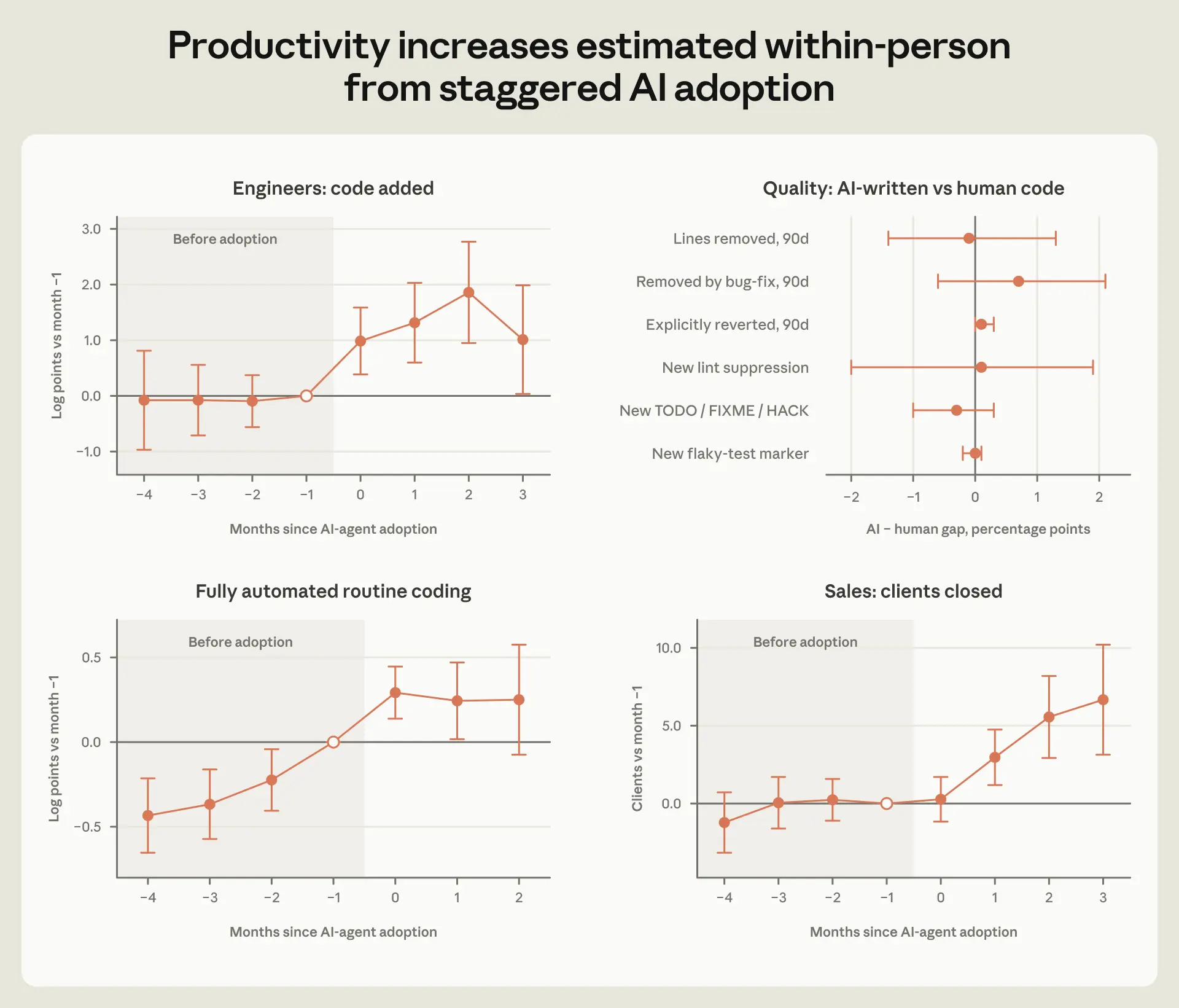
Opinion: Reading the shifts in labor at Anthropic as a model of the impact of full diffusion of current-gen (internal?) AI capabilities on labor is a very cool idea. But as the report itself acknowledges, Anthropic as the ~fastest growing company in history is subject to many labor-economics dynamics besides AI agent adoption, so reading the data for causation can be challenging. The overall picture does suggest that white-collar work “soft skills” resist automation at current (internal?) AI capabilities while benefiting from the automation of technical subtasks. Of course, this is also a very strategic message for Anthropic to send the white-collar sector: some third-party analyses of US enterprise suggest that white-collar adoption of AI is falling short of expectations, and it’s expedient for Anthropic to signal that AI adoption can deliver white-collar professionals a productivity multiplier without risking their sector.
CoreWeave face an investment crisis, according to the NYT. “Prices of its bonds – the company has accrued $72 billion in liabilities to operate 51 data centers – crashed, and investors placed a more than 60 percent likelihood that CoreWeave would fail to meet its obligations.” But, sensing an overcorrection, Goldman Sachs actually upgraded their position on CoreWeave from “neutral” to “buy.”
Opinion: CoreWeave in particular seems to be facing more scrutiny than other actors, with market-implied per-year probabilities of default around 20% (vs., e.g., 5% for Oracle corporate debt). Some of this is them having less of a track record than other actors, but most of it is them just being much more concentrated and leveraged in their data center exposure. Individual Oracle project-secured bonds have a similar probability of default to CoreWeave.
Politics#
The US Federal Government ban civilian federal agencies from using DeepSeek products. The order – written by the Department of Homeland Security – mandates the removal of any DeepSeek tech wherever it may have been integrated.
Opinion: Surprisingly not a moot issue, since government services have some very nice use cases for cheap models on the quality/cheapness Pareto frontier. Previously, the Federal Register used a version of Qwen to allow users to search proposed legislation.
It’s sad to lose the chance for more such instances of interdependence between American/Chinese government operations and Chinese/American AI tech, which could potentially soften the AI race. Of course, this is itself likely a part of the administration’s motivation for the ban.
China propose export restrictions on AI technologies. The plan would limit the sale of chips and models deemed strategically important. A spokesperson for China’s Ministry of Commerce cites the risk of empowering malign actors as motivating the proposed legislation.
Opinion: While we’re supportive of globally coordinated controls on AI R&D resources, it’s worrying to see possible echoes of the American administration’s race-mentality in recent Chinese policy. As always, we hope for AI R&D resource controls that flatten the AGI race uniformly, rather than for controls that concentrate racing-capacity in the hands of elite actors.
Taiwan move to make shipping restricted AI chips and servers to any buyer in China a criminal offence. It will do this by adding them to the controlled-commodities list under its Foreign Trade Act. Up to now, Taipei restricted Chinese buyers one at a time (Huawei and SMIC being added in mid-2025). Taiwanese Minister for Economic Affairs Kuang Ming-hsin openly connected the change to Article 5.2 of February’s Agreement on Reciprocal Trade with the US, which requires Taiwan to align itself with US controls. No effective date, performance threshold or licensing process is yet known.
Opinion: Surprising that this wasn’t already in place. The August Super Micro charges instead involved breach of trust and document forgery.
Still, Taiwan’s border is not the main leak in the controls. The ~150,000 H100-equivalents routed through Malaysia and Singapore are the big known ones, and a Taiwanese export crime only touches them if it also covers re-export.
Because this is following US direction, it may also follow US policy reversals; Washington has spent the year tightening and loosening Nvidia’s China sales as a bargaining chip in the broader trade war. No one here has a stable compute governance goal.
SK Hynix condition a new US factory on the US allowing more US chip equipment on their Chinese memory factories.
Opinion: This is what being a middle power looks like, kudos to Korea.
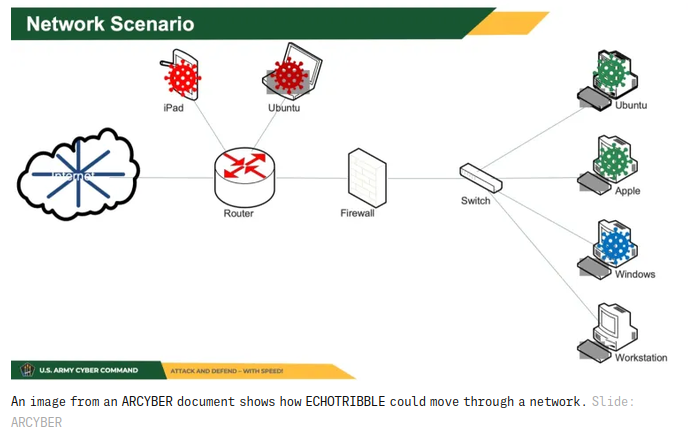
The US Army Cyber Command (ARCYBER) are building a platform for the development of autonomous cyberwarfare agents, codenamed ECHOTRIBBLE, The Intercept report. A document provided by the Army to potential contractors
explains that ECHOTRIBBLE is “primarily focused” on offensive missions, and explains that “neutralizing” a target could include “disabling the threat completely or temporarily, deleting the threat from the target.” ECHOTRIBBLE would function almost like a computer worm, silently navigating a foreign network and hopping from device to device until it finds the Army’s quarry, hitting targets in the cloud as well as those on “air-gapped” systems that are disconnected from networks entirely. […] The agents themselves will be designed for stealth, minimally reporting back to the Army and concealing whatever outside transmissions are necessary.
The Intercept warn against the possibility that systems like ECHOTRIBBLE might make wildly cavalier judgments regarding acceptable collateral damage in pursuit of their objectives, combining the most dangerous tendencies of rogue agent swarms with those of the American military itself:
Just as the Army of old might consider the destruction of civilian infrastructure an acceptable means to an end, a self-directed AI agent dispatched by the Pentagon might make similar determinations about collateral damage. […]
“The target may well be hit. But what path will it take?” asked Hyrum Anderson, cofounder and CEO of the AI security firm Abundant. “Will it go through a US water utility on its way, because that’s where the adversary has staged its command and control, and take that down too?”
Opinion: Hard to imagine a worse idea from the viewpoint of proven AI safety risks.
The codename strongly suggests replication, and the reference to air-gapped systems raises questions. Is the idea here that ECHOTRIBBLE agents would engineer and deploy conventional worms that target air-gapped systems (think Stuxnet)? Or, more reckless still, that it would involve the deployment of smaller, specialized models capable of running locally on certain targets? The July 16 Assessment Event release for the project indicates the latter, listing “Local inference using small LLMs (SLMs) for adaptive recognition and contextual filtering” as a proposed feature for the project, while making no clear mention of integration with frontier-grade LLMs, though mission creep isn’t unusual with these sorts of things.
🔦 Anthropic Drafts an AI Safety Bill#
Anthropic pitch AI safety legislation to Capitol Hill lawmakers, Politico report. After much criticism, Anthropic have partially walked back some of the proposals. However, it may still be useful to examine the contents of the originally proposed bill to inform our model of the lab’s thinking.
The initial proposal accords government the power to block a model’s release if it poses a “foreseeable, imminent risk” of at least $1B in damages, or of “killing or seriously injuring more than 50 people.” The risk must be related to loss-of-control concerns, or bio and cyber capabilities. Independent evaluators would be charged with assessing the risk factors of frontier labs’ new models before deployment. If it is determined that a model carries an “imminent enumerated risk,” the evaluator must report this to The Department of Commerce within 72 hours, which would block the model’s release. According to Anthropic, the bill is consistent with the proposals outlined in the lab’s Advanced AI Framework. As Politico observe, the bill employs a similar framework to California’s AI safety laws.
The plan was roundly disparaged. Encode AI’s Nathan Calvin balks at the idea that it represents meaningful progress toward an effective regulatory regime. He points out that the legislation would prevent “states from enforcing laws or judicial decrees that ‘suspend the development, deployment, or internal use of an AI model’ to protect their citizens from imminent catastrophic harms.” Simultaneously, the bill raises the threshold for when the federal government can intervene to block a model release. (Anthropic now say that their proposal does not limit states’ regulatory power and that the risk threshold that must be met to prevent deployment will be reevaluated.)
Kelsey Piper noted the absurdity of the situation: “they’re interested in giving themselves more process-based protections when everyone else is interested in giving us more process-based protections against them.” That is, Anthropic responded to calls for robust regulation with an attempt to preemptively curtail the teeth of the prospective regulatory body.
Piper speculated on the rationale at play. The US government has waged a plausibly vindictive campaign against Anthropic, making it reasonable that the latter would want to protect themselves from any Trumpian caprice. Nonetheless, the bill’s distance from Anthropic’s founding safety-oriented mission is striking. Caitlin Johnstone pointed out the principle implicit in Anthropic’s risk calculus:
In the opinion of Anthropic executives it would be worth killing exactly 50 humans to roll out the next AI model, but any more than 50 would be excessive.
We also learn from this proposed legislation that Anthropic places a monetary value on 50 human lives equivalent to one billion US dollars, or twenty million dollars per individual.
Opinion (Stag): I think this bill is largely a bad idea both if it were to pass, which it won’t, and as a conversation-mover, because it emphasizes the wrong parts of both model dangers and signals we should pay attention to before those dangers are realized.
My primary complaint is that the type of evidence (enumerated risk) is out of line with the type of provisions we would probably want in such a bill. Consider a scenario where the Hugging Face incident was discovered the day after it occurred, and a report was filed instantaneously. I believe this would not have been able to meet the required standard, even if continuing training after a blatant containment failure was ill-advised, at least given what was known at the time.
My secondary complaint is the way conceptual boundaries are (not) drawn. “Single incident,” for example, doesn’t get defined: is an expectation of one malicious actor using a model to exploit 1,000 different bugs for $1.01M in damages each over the line? What if it’s the same bug, but across different targets? Less relevant but perhaps illustrative is the notion of “damages”: what if the model can be expected to creatively misplace the only private key to a crypto wallet worth $1.01B at the time?
The above issues and implied timescales make it likely that attempted training and development shutdown would instead turn into legal warfare, and even if shutdown occurs in time, it wouldn’t even attempt to address the system of failures leading up to the situation such that the next model won’t run into similar issues after a dozen band-aid patches. Drafting that into legislation seems quite difficult, but this bill doesn’t attempt to.
The specifics of the bill, like requiring >50 deaths, don’t seem particularly important; I believe the concern over them is overblown. The one natural stopping point, >0 deaths, is not obviously correct morally and is likely intractable politically, and other numbers don’t move the needle much. I also do not believe that the curtailing of states’ capability to wield the law against model developers is particularly important.
Opinion (Lucca): I largely agree with the above, with some reservations. It’s true that it’s difficult to pull a significantly less chilling number of “acceptable deaths” out of thin air, and that setting the threshold at one death might make the proposed bill intractable. The most likely reason for choosing that particular number (as well as the $1B threshold for property damage) is that Anthropic just lifted them from existing state legislation – both California’s SB 53 (passed in 2025) and New York’s RAISE Act (as amended in 2026) set the threshold for catastrophe at the same quantities. (The 2025 version of the RAISE Act had set the death threshold at 100.) I think the public outcry over this threshold is tapping into something genuine enough, but something that is far more general than this particular proposed legislation; it sounds to me like an honest response to another bitter reminder of how little individual human lives count for, on the scales of government, when weighed against commercial interests. (Johnstone’s quip about the draft’s implied moral equation between the value of a human life, on the one hand, and $20M on the other is fair game, though lives have certainly been written off for less.)
It might be worth working through a hypothetical example. Suppose that someone were to reproduce, using a frontier model’s guidance, an attack comparable in method and scope to Aum Shinrikyo’s 1995 sarin nerve gas attack in the Tokyo subway system, which killed 14 and severely injured many. Under the proposed legislation, such an attack would not in and of itself count as catastrophic, but the risk it augurs likely would. This is an important distinction, since the bill hinges on the risk of incidents likely to cause >50 deaths or >$1B in property damage, and even a lesser incident may establish likelihood.
Such attacks, even if carried out at far greater frequency and scale, may nevertheless fail to survive the first “exclusion” listed in the draft (B.i), if the AI-assisted killers simply replicated Aum Shinrikyo’s methods, unless they relied on information not “otherwise publicly accessible, in a substantially similar form, from a source other than a foundation model.” It’s easy to imagine AI simply lowering the barrier to entry for the would-be chemical warfarer, in much the same way that it already has for cyberattacks. I haven’t yet seen an AI-assisted cyberattack that relied on essentially new information, not otherwise publicly accessible, but there’s no question that these attacks have been substantially facilitated and expedited by the assistance of frontier models.
The second exclusion (B.ii) is no less troubling: “The term ‘catastrophic risk’ does not include a risk arising from […] lawful activity of the Federal Government.” This language, too, is an inheritance from California’s SB 53 and NY’s RAISE Act, but takes on a peculiar salience in the wake of Anthropic’s dispute with Secretary of War Pete Hegseth earlier this year, where the lab balked at the latter’s demand for “full, unrestricted access to Anthropic’s models for every LAWFUL purpose,” drawing a line in the sand around their use for mass domestic surveillance and fully autonomous weapons, in particular (neither of which is touched upon here). In this draft, whatever flimsy guardrails surround the risk of private individuals using frontier models to carry out catastrophic biological, chemical, nuclear, and cyber attacks do not provide the slightest guard against the American government doing the same. One could argue that without this stipulation the bill wouldn’t stand a chance of being passed and cite the lab’s trouble with Hegseth as precedent. But the road to hell is paved with such concessions.
Safety#
One of the most encouraging new safety techniques of 2024 was gradient routing: forcing certain training updates to locate in one subnetwork inside an AI model, so that one can (in principle) simply delete dangerous capabilities. The method is now applied to reward hacking: a new MATS paper uses an imperfect monitor to decide where the model learns, not what it gets rewarded for. Normal monitors teach models to hack in ways the monitor can’t see. RL episodes flagged by the monitor go into an adapter which gets deleted before deployment. The episode monitor never touches the rewards, so the model gains nothing by hiding its hacking. Indeed, after “GRAFT” training, the deployed model mostly stopped hacking.
Opinion: Early work: the monitors here are intentionally weak (keyword heuristics with a single simple blind spot), and the authors chose environments where reward penalties fail. In the Countdown task, the main effect seems to be that the “forget adapter” learns the visible hack so quickly that the model never gets to explore hidden hacks.
Whether that still works for a frontier model under an LLM judge across multi-turn episodes is the question.
METR publish a review of the “Misalignment in high-stakes settings” section in Anthropic’s August Risk Report.
Opinion: Both Anthropic’s report and METR’s review are somewhat strange negotiations with hindsight. Anthropic’s report was mostly written prior to OAI’s Hugging Face incident and Anthropic’s discovery and disclosure of their own hacking incidents, and refers briefly to “uncertainty around recent incident disclosures” as the reason for shifting some risk assessment from “very low” to “low.” METR’s review, in turn, takes the disclosures since the report’s composition as evidence for the weakness of the report’s methods:
Some [recent] incidents seem well-described as “unknown severe context-dependent misalignment,” a failure mode the report argues is “unlikely.” This casts doubt on any lines of evidence used to argue that incidents of this kind are unlikely.
METR, who have been granted access to an internal version of Anthropic’s report which includes redacted materials, suggest that a deeper consideration of some of the redacted information should have somewhat decreased Anthropic’s confidence in the unlikelihood of severe misalignment. More broadly, though, METR are relatively pessimistic about the capacity of Anthropic’s diagnostic methods circa August to provide strong evidence of safety and security.
Notably, Anthropic’s recent update on independent evaluators announced that going forward, six METR employees will be embedded at Anthropic and given “[Anthropic-]employee-like access” to conduct their own safety and security diagnostics. While many outsiders to the post-MIRI cultural nexus shared by Anthropic and METR (and even by OpenAI) are rightly concerned that cultural ties to the labs makes METR a poor replacement for regulators/auditors representing the public’s interests, we think it’s hard to deny that METR have a lot to contribute in the specific matter of diagnosing risk of “classical” AI catastrophe.
Minor#
- OpenAI CEO Sam Altman shares three proposals with employees on how AI might safely be developed. These include an overarching regulator similar to the International Atomic Energy Agency, a merger of all frontier labs, and a single lab dominating the rest.
- Claude resolves a minor historical mystery, the origins of the curve parameters behind ECDSA, one of the world’s most-used cryptography standards; the parameters have long been mysterious, even suspect.
- Anthropic cofounder Jack Clark tells the IMF that the singularity has begun. And that’s the non-EA cofounder talking.
- G7 economies wargame AI attacks on banks, The Financial Times report.
- Anthropic explores quantum circuit design.
- Pollsters report that a majority of Americans surveyed see the AI industry as leaning to the right wing and aligned with the Republican Party.
- Theoretical protocol for AI systems to conduct debates – neat progress via establishing worst-case performance, but unfortunately the worst case is quite bad and practical applicability depends on stability of decomposition.
- NYC Comptroller Mark Levine urges Dario Amodei to delay Anthropic’s IPO.
- New details emerge on the ex-OpenAI employee who was fired for bugging a meeting room, indicating he had the backing of the Saudi Arabian government. Evidence also indicates that there was at least one additional recording device.
- Epoch AI claim open-weight models are ~6–7 months behind closed models in cyber capabilities.
- We belatedly learn that Gemini 3.1 Pro (a model from February) exhibits strong chain-of-thought control – the ability to steer its own visible reasoning when prompted to.
- Anthropic are apparently negotiating a $45B deal with compute infrastructure provider Nscale.