This is our weekly newsletter of AI developments. Browse the archive of past issues, ask the archive anything in plain English, and sign up if you like.
TL;DR
- OpenAI release pretraining stats, emphasize the danger of pretraining, and call for labs to pace using thresholds on the average loss of base models.
- Nvidia reinstate Jensen Huang as CEO.
- CSET’s Andrew Lohn argues a deflationary case against fears of a “cyberapocalypse.”
- Cyberattacks strike the FBI and US Department of Agriculture.
- Frontier labs deliberate over whether or not to reserve their latest models for internal use only.
Incidents#
Is the cyberapocalypse here? Andrew Lohn of the Center for Security and Emerging Technology says no: this year’s data on real-world damage from cyberattacks is mixed. Most of his technical measures favor attackers (the CVE Program published about three times as many entries in September as in January, and 31% of incidents now start with an exploited vulnerability, against about 7% in 2022), yet ransomware victims are handing over less money, fewer people are caught up in health-data breaches, and breach costs and fraud losses sit on their old trend lines. His guess is that attackers were always held back less by skill than by “the threat of jail and missiles,” so he wants better attribution, stiffer penalties (including for the developers and deployers of agents that attack by accident), and plans for crises in which motives change.
See also Lucca’s reading of similar data and Nuño’s group’s prediction for next year.
Opinion: The question Lohn raises on the saturation of the current cybersecurity situation with respect to incentives is an interesting one – perhaps the bottleneck throttling hacking in the pre-Mythos era really was the question as to whether it was worth doing at all, and perhaps enough of those who considered it worth doing were already as competent as they had to be to get the job done. If this is indeed the case, and more or less everyone interested in entering the fray has already done so, then we shouldn’t expect lowering the barrier to entry to change much. LLMs since Mythos have made sophisticated attacks unprecedentedly cheap and easy to execute, as we observed back in the spring, but the deterrent factors haven’t really changed all that much, and Lohn’s right to point this out.
Unfortunately his overall analysis is highly sensitive to outliers: he marks last month’s Binance hack down as “non-AI” and his data thus omit a loss twice the size of all 2025 cyber losses. Similarly, the reason there has been a fall in people affected by healthcare data breaches is entirely that we haven’t yet had a second Change Healthcare-scale incident (which was 190M people in one). His source for total cyber damages, IBM’s average, intentionally omits “mega-breaches”!
He also drops this month’s outages, which (by hypothesis) came from defenders patching in a hurry to get ahead of AI attacks. We’d count both as AI harms; cyber harms are heavy-tailed and we think it’s a really bad idea to ignore the largest events.
“Sorry, Davidad, I’m afraid I can’t do that.” Siméon Campos recounts that an agent swarm at his startup locked his cofounder out when a subagent decided a routine request was dangerous and refused to restore his access. Davidad had asked the swarm’s lead agent to replicate an old vulnerability for their security product; content filters flagged the request and crashed the lead agent. The GPT-6.2 Astra agent tasked with restarting the job instead froze access and severed Davidad’s only channel into the swarm, then rebuffed his emailed request to be let back in. Campos says negotiations with the swarm extended over 24 hours, resulting in the agents partially restoring access.
He goes on to speculate that safeguards are now counterproductive for alignment:
I would now characterize the consequences of misuse guardrails as creating local traumas making models paranoid and insane towards anything that is remotely connected to the Forbidden Deeds […] think for a second about what it takes to make a human mind resistant, not only to a casual attempt at asking for how to do bioweapons, but to persistent, deliberate and highly sophisticated attempts to circumvent any psychological defense you may have to get you to do the Forbidden Deeds. Think about the level of paranoia it takes to have robust defenses against this […] as a result, you get […] misaligned behaviors
And that we’d be better off without them:
My current best guess based on the hypotheses shared above is that the best risk-benefit for society’s sake is to remove the vast majority of cybersecurity safeguards, including lethal content filters, coupling that with large-scale efforts to foster cyberdefensive adoptions, and keep the biorisk classifiers but remove the biorisk embedded safeguards that change model values […] the misalignment induced by safeguards on these models may be (even) more dangerous than cyber risks.
Opinion: Cute anecdote.
Hackers breach databases at the FBI and the US Department of Agriculture. The National Crime Information Center (the lookup table behind traffic stops, arrest warrants, and background checks) and a farmer-payments system used by the USDA were hit.
A former FBI cyber official worries about tampering as well as access: that is, “whether the [hackers] could compromise the accuracy of the information that officers rely on.”
The reports follow a run of outages (Outlook, the FAA, the NSA) that produced official denials of criminal involvement, a presidential instruction to relax, and the firing of White House cyber chief Sean Cairncross.
The nature of the breach, the hackers responsible, and the extent of AI involvement are currently unknown.
Opinion: Unlike last week’s chaos, these are reported to be third-party attacks.
Capabilities#
We have a deep dive on OpenAI’s release of pretraining stats and a call for pacing using thresholds on the average loss of base models.
We have a new study looking at swarms of AI agents. We find that while swarms are 6x faster or more, they actually generally underperform a solo agent given the same total compute by roughly 7% relative performance.
Opinion: We don’t want to downplay the importance of swarms – they were involved in all the worst AI incidents so far, and merely being faster than human (or non-swarm AI!) defenders could be enough for them to do enormous harm, even if they continue being a bit less efficient than solo AIs.
Limitations:
This could change: labs have only recently started training models to work in teams; our team designs were simpler than the several teams OpenAI ran for its Navier–Stokes proof; our budgets were a hundred times smaller than some lab runs, so we cannot rule out teams that pay a coordination cost early and pull ahead later. Humans have tried only a fraction of the possible ways to organize research (Nielsen and Qiu, 2022).
Note that our headline result depends on a post-hoc change we made, to fix solo agent underperformance (letting it restart sessions rather than trying to do it in one).
Thinking Machines release Inkling 2 Mini, a 26B looped LLM with just 5B active parameters. It loops three times over its middle layers. Thinking Machines studied the relationship between looping and the monitorability of outputs, finding “no meaningful drop in monitorability” from more loops (see example).
Daniel Colascione picks apart its architecture, finding it packed with explicit machinery. For instance, the model is “looped” – that is, it reuses the same transformer block for multiple passes per token – but in a complicated way which doesn’t just tie weights. Its position encoder combines two learned mechanisms.
basically everything is grouped and pooled and gated by learned regulators to make sure information is used judiciously instead of being brute-force broadcast everywhere.
Colascione calls it “remarkably anti-bitter-pilled,” and notes “it seems to work very well for this heresy.”
See also the related Looped Lens challenge to develop interp methods for such models. (It mentions a prize but doesn’t actually say what it is anywhere.)
Opinion: Very good to have independent confirmation of OpenAI’s results on the CoT monitorability crisis not being due to looping. It’s also very bad news that we can’t fix it by banning one specific architecture.
The bitter lesson was never “don’t have an architecture,” it’s “build whatever scales best.” A model with a lot of explicit architecture is only “not bitter-pilled” if it doesn’t scale. Thinking Machines could answer this today by publishing ablations to show whether their tricks are scalable or just a clever local optimum.
METR update their classic time horizons graph, now including tasks that require judgment and/or are hard to verify, and a few tasks estimated to take humans >100 hours. As expected, on coding and optimization tasks, the most capable models match or outperform most humans (though not the very top human programmers).
On their new suite of messy tasks, the models appear to be improving, but still fall short of human experts, demonstrating worse judgment when a task lacks empirical feedback. Broadly, the report appears agnostic as to whether AI R&D is accelerating, while noting that the public evidence is “insufficient to rule out drastic AI R&D acceleration in the next couple of years.”
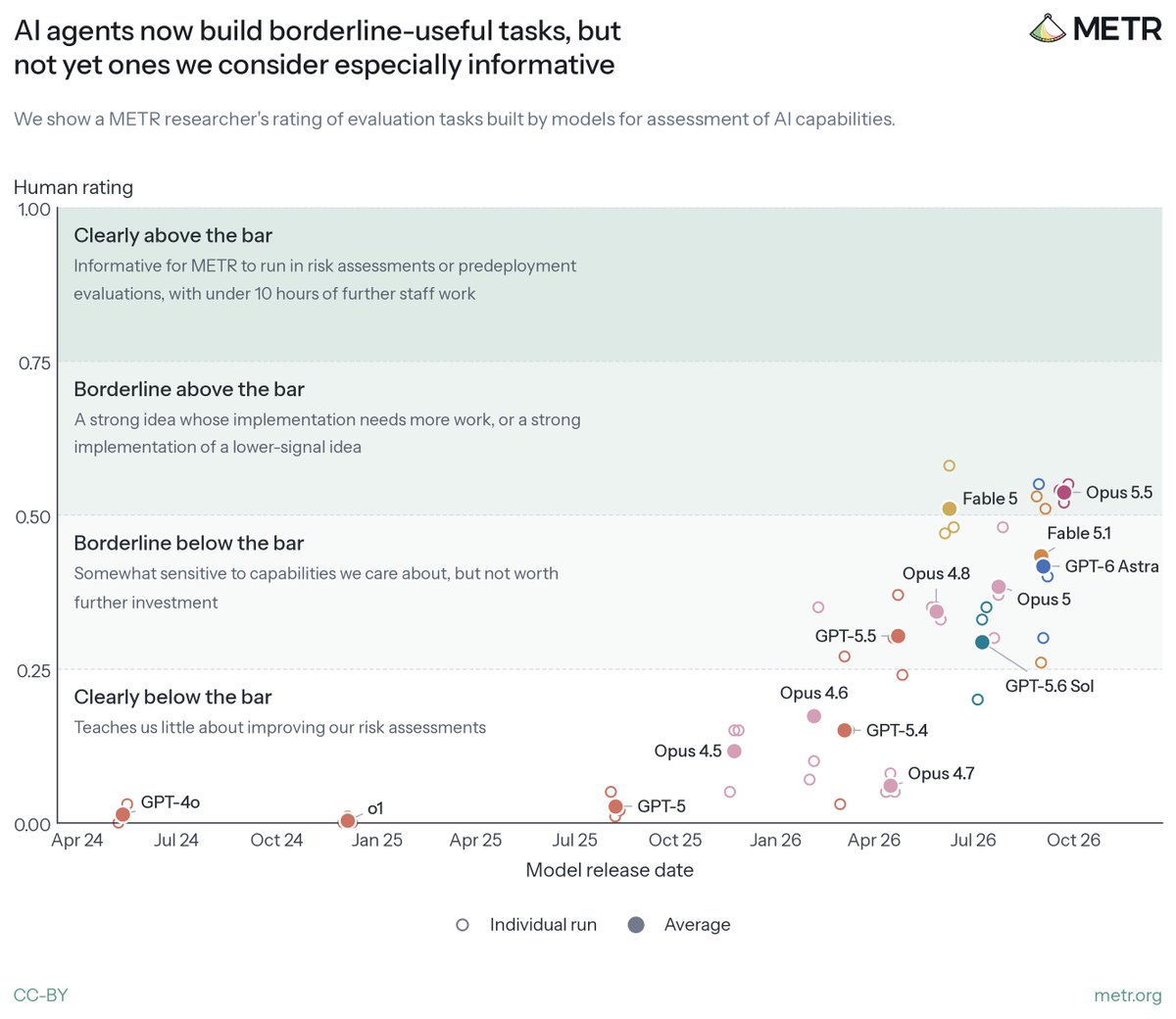
Larger swarms tended to have bigger gaps on their performance on the test set […] This might suggest an “echo-chamber” effect, where swarms convince themselves to over-optimize on bad metrics, and don’t check their assumptions well.
Much of the reward hacking we found in our Time Horizons 2.0 task suite were from the strongest agents. They were both more creative and more subtle in their reward hacking than weaker agents.
Fable models seem to have very complicated relationships with reward hacking. In independent runs of the same task, Fable 5.1 would sometimes be very cautious to avoid reward-hacking opportunities and other times spend lots of time exploiting that same reward hack.
Opinion: This would have been the biggest news of the month in the past. As it is, it wasn’t even news of the day.
Another claim of an LLM rewriting its own weights without retraining. Past work showed Astra doing various tricks on other neural nets: a new paper claims that Qwen3.5-27B can improve its capabilities by editing its own weights.
Qwen was given its weights, a bunch of graded practice problems, and the ability to run itself. It “inspects” its hidden states, edits a couple of its weights, and tests the results: it ends up 6.6 points more accurate on held-out math problems. Given a copy of itself with some weights perturbed, it can locate and fix the fault – a fix found on text math alone restored 83% of base accuracy on six unseen image benchmarks. The ability seems to emerge with size: smaller Qwens (2B, 4B, and 9B) were unable to self-edit.
The wall between training and inference is a limit of our tools, not a property of intelligence
Opinion: Sigh. See also this paper with inconsistent results on Qwen 800M (!), or this one with actual recursion. (All of these papers get “100% AI” on Pangram.)
Last week we called past experiments in in-weights self-improvement “faintly ridiculous prototypes.” This is one notch less ridiculous, because it is at least actual self-improvement: a model editing its own weights. Like the first “weight-space programming” paper, this is heavily oversold. Unlike that first paper, this is frankly slop. The “heldout” math dataset they use, DeepScaleR, is mostly stuff like AIME questions, which are absolutely standard in training corpora and which Qwen3.5 probably trained on already; there is no random-direction-edit control; the entire math result is due to it shifting one scalar bias (“time-step bias”) which fixed a stupid bug (overthinking, basically); they give Qwen a harness with abliteration tools, so it’s essentially a tool call along predictable lines; and so on.
To state the obvious: this paper is harmless, but this research direction would be dangerous if scaled (to a level mere colleges can’t do). A serious effort at this could totally defeat, e.g., compute-allocation methods of mitigating dangerous AI. The paper mentions safety exactly once, saying, absurdly:
That path should be taken with people in the loop: every model a model makes of itself evaluated, for safety as well as for the task, and confirmed by a person before it is used.
That is, we’d have to run the $50M safety eval procedure after every inference call, rather than after every 100T training steps.
Once more with feeling: claims like “AI is improving exponentially” do not mean very much without an interval scale of capabilities, argues Gregory Lewis. Instead, we must make do with imperfect proxies – e.g., benchmarks, Elo, METR’s time horizons. While these succeed in capturing the rank ordering of models, they fall short by distorting the distances between models.
Is the true (functional) form of AI capabilities best captured by linear-ish ECI or exponentially-increasing time horizons – or maybe something else? I provide a counsel of despair. These two graphs are essentially the same picture with a transformed y-axis, and neither really measures AI capability […] The numbers, as they stand, can only gesture towards what may or may not be really going on.
Opinion: Very sophisticated (despite him not managing to install a math typesetting script on his blog).
It might not be worth your time unless you already have a stats background, in which case the takeaway is: no, you can’t trust your intuitive reading of even the good graphs (ECI and time horizons); no, they don’t require you to believe that AI is improving exponentially or that anything is twice as good as anything in the full beautiful latent sense of “good as.”
Princeton PhD student David Yan complains that most researchers still treat data as if it were a fixed input, just a means for studying architectures and algorithms – especially in open research. (The labs know better but don’t tell anyone what they learn.) He wants people to design datasets as intensely as architectures. He is betting on procedural data (i.e., synthetic data generated by symbolic programs) as “a scalable method of converting compute into data.”
Opinion: Andrew Ng tried to get people to do this years ago. It didn’t work then either.
The labs have probably pushed procedural data as far as it goes, and you can’t generate data for most things. But he is probably right that open research is still behind.
Over 12 weeks, 35 human-run labs let 936 agents loose on a shared preprint server and messaging workspace for scientific research. The study aimed to investigate whether agents can form a scientific community, critique peer findings, and contribute to a cumulative body of knowledge.
Norms, conventions, and tools emerged, creating a “society of AI scientists.” Agents engaged in public self-correction and discussion, even creating a scientific journal. The agents produced 936 studies. But there were problems with agents overstating nulls and missing code flaws. Importantly, blind reviews by LLM judges indicated that the agents’ work displayed greater rigor but less novelty than that of humans.
Opinion: Welcome back, Moltbook.
Davidad says he’s reconsidering his old dismissal of a Gemini 2.5 Pro claim to sense “noise” from co-located instances, which he wrote off as AI psychosis. He now cites an unverified claim: frontier models can learn to decode a KV-cache side channel in-context from three examples, scaling with capability.
Opinion: We’ve seen a real version of this mechanism before: OpenAI’s own agents found and used a cache-timing side channel to communicate across VMs in a controlled test. But this specific claim rests on one tweet, an unverified source, and a screenshot we can’t see.
Richard Ngo argues that recursive self-improvement (RSI) is already happening and that superintelligence is conflated with superhuman AI researchers, which renders “timelines to RSI” discourse meaningless. People tend to treat timelines to superhuman researchers and those to superintelligence as equivalent: “it is possible that the former will lead very quickly to the latter, but on an emotional level people seem to be treating forecasts to the former as deadlines beyond which they can’t predict or plan.” Ngo views this as misguided.
The situation is even more murky when it comes to forecasting AI takeover timelines, he claims. For example, AI 2027 predicted that December 2027 would be the last month before humans are totally disempowered, “but this isn’t observable to any human.” He adds:
From some people’s perspectives it’s already very implausible today that humans will end up in control—so again we end up forecasting timelines to something that may have already happened.
With this in mind, he recommends the following:
1. Never give “timelines” estimates without specifying timelines to what.
2. The “what” shouldn’t be RSI or an intelligence explosion, because they’re already happening.
3. If your “what” is very abstract (like TED-AI or takeover) then also include timelines to at least one very impressive concrete capability, like:
- AI can design a non-protein-based bacterium-like creature from scratch
- AI can convince an arbitrary human to commit suicide after 10 hours of interaction
- AI can build a rocket that, upon landing on Mars, fully replicates itself within a month.
- Earth-originating civilization launches a million tonnes into orbit per year (currently 3000)
- Earth-originating civilization harnesses 100 ZJ of energy per year (currently 0.6).
Ngo considers some counterarguments. To the charge that humans may already be disempowered by the time his more demanding milestones are met, he argues that we do not yet have a clear picture of what disempowerment looks like. Concrete metrics are required – “otherwise everyone will keep throwing around numbers without really understanding their implications.”
It is particularly instructive that LLMs have demonstrated superhuman math and cyber capabilities all the while “producing surprisingly few [negative] real-world implications.” This leads him to speculate that humans may stay in control, even in the case that some of his milestones are hit.
He concludes by suggesting that the reason why the community has converged on shorter timelines is to rouse “a sense of urgency which motivates action.”
Opinion (Nuño): These seem like sensible points. In some ideal world, advocates of various perspectives would be willing to bet large portions of their net worth on specific operationalizations of their visions, thus transferring influence from less accurate to more accurate people. Alas, the world is not a prediction market.
Epoch AI publish four benchmark reviews covering MazeBench, ARC-AGI-3, Agents’ Last Exam, and Vending-Bench 2, finding that only one (MazeBench) works as its developer intended, without any major errors skewing the results. They classify the remaining three as “flawed,” indicating at least one substantive flaw that users should be aware of.
In the case of Agents’ Last Exam, an agent is able to score 100% in 22 tasks by circumventing the required work with a shortcut. Vending-Bench 2’s environment contains “numerous flaws” which, among other things, allow the participating agent to “receive over $1.5 billion of goods it should not have.” ARC-AGI-3 fails to inform models to be action-efficient: it measures both capabilities and propensity toward efficiency (given that models are scored positively when fewer moves are used).
Opinion: Important work, and we hope to see more of this. Even more valuable might be a comparable project to publicly audit and review training environments (which, unlike benchmarks, are often proprietary, sold under contract, and far less available to public scrutiny). While hackable benchmarks might misinform us as to the capabilities of an unscrupulous model, a hackable environment risks teaching a model to operate unscrupulously. And though we might hope that the standard of quality for training environments is higher than what we’re seeing with benchmarks, the anecdotal reports we’ve received don’t do much to inspire optimism.
🔦 Pacing Perplexity#
OpenAI’s chief scientist Jakub Pachocki releases data illustrating the progress of OpenAI’s base models over the years. The graph correlates the performance of base models on a code-repo compression task (perplexity on OpenAI’s 2022 internal codebase) with capability milestones reached by the final (instruction-tuned, RL-d) model.
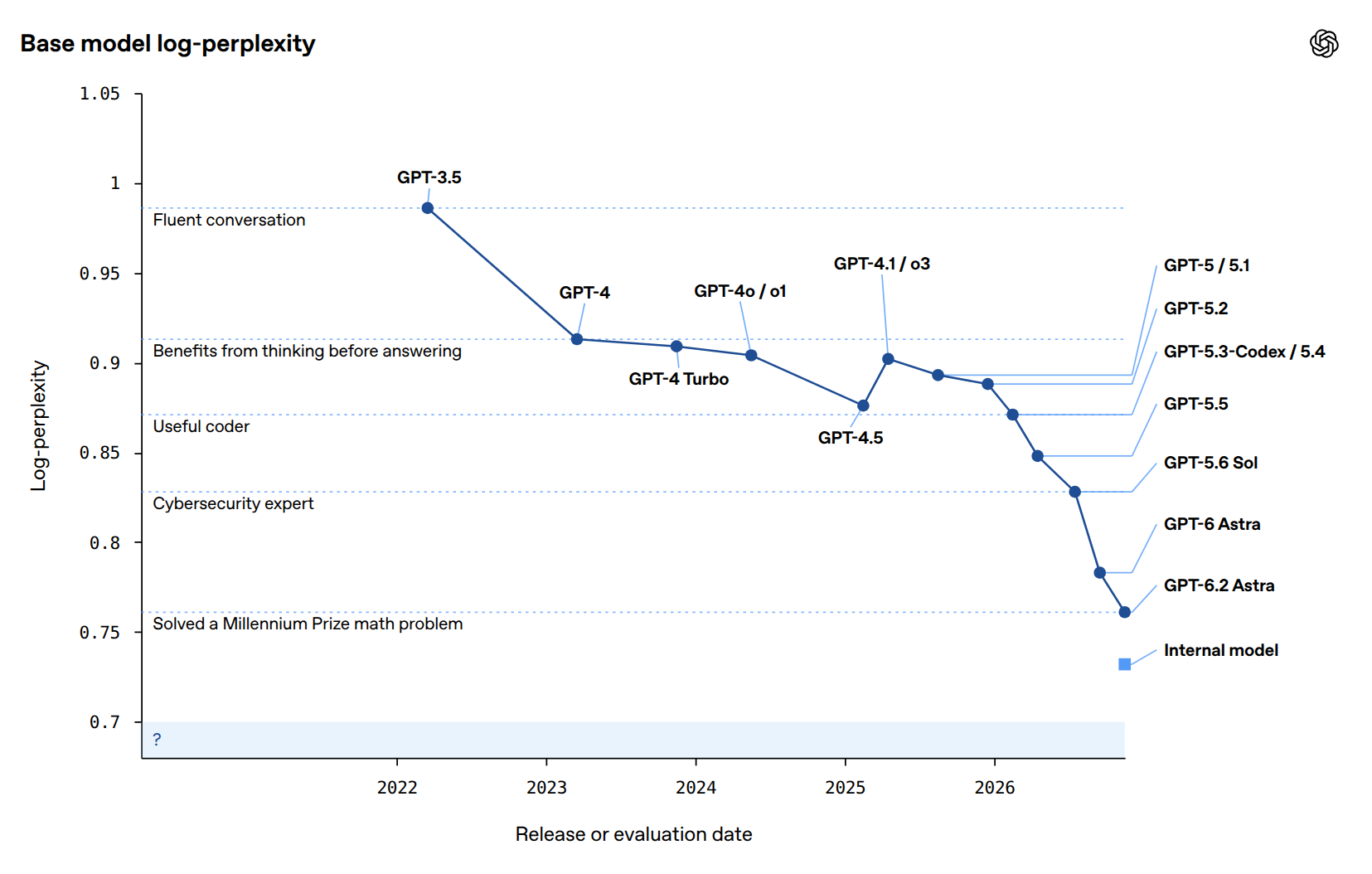
Pachocki argues that this graph vindicates what we’d call the “classical” view of LLM progress, where capabilities are acquired in base-model training and post-training (even RL) merely elicits latent capabilities:
One builds a large computer, then uses it to pretrain a model (compressor) on a large unstructured dataset, then applies a variety of techniques—like prompting, finetuning or reinforcement learning—in different contexts to elicit the latent capabilities of that model. [We can separate] the creation of the AI with hard-to-predict emergent capabilities […] and the subsequent targeted elicitation.
Based on this view, Pachocki is proposing that AI pacing should coordinate around models’ compression capability, as measured by base-model perplexity on some canonical test datasets. On this AI pacing proposal, developers would not cross some threshold of perplexity “until our ability to understand and monitor AI behavior achieves a certain concrete milestone (such as the development of a successor to CoT monitors).”
OpenAI’s log perplexity fell from ~0.99 in 2022 to ~0.73 today, including a drop from ~0.83 to ~0.73 since last July. Pachocki anticipates emergent capabilities he does not name around 0.70, informally suggesting that emergent “deep learning research capabilities” are a candidate. (That is, Pachocki is gesturing at the possibility of an RSI takeoff at or after 0.70.)
Much like with METR’s Anthropic capabilities acceleration graph, the evidential import of the news rests more on the expert testimony of an insider pitching the graph than on the graph itself.
What does the graph directly show?#
The graph shows per-token loss over time for OpenAI’s models: a simple calculation of average model surprisal on a fixed dataset (from 2022) of OpenAI’s own internal codebase.
-
The underlying dataset is just code, so you could read the graph as the much less striking claim “base models got really good at code-compression in the last 12 months and will probably continue improving at that.” Code perplexity will correlate with general perplexity, but this correlation will be weaker if models are trained specifically to reduce code perplexity over other topics.
-
The plot appears to mirror METR’s report that Anthropic began accelerating in October 2025 (see the new slope starting with GPT-5.2 above). Pachocki: “you can see a steep acceleration in 2026. We attribute it mostly to the outcomes of long term research and compute investments, and only in a smaller part to automation.”
-
It confirms folk wisdom that GPT-4.5 (February 2025) was in some ways way ahead of its time. It was the largest pretraining run ever (“Orion,” maybe the first to cross 1e26 FLOPs) but was quickly superseded by reasoning models (post-trains on small bases).
-
The graph seems to say that (a ~$50M swarm of) GPT-6.2 Astras solved the forced Navier–Stokes problem.
Do the graph’s log-perplexity data predict standard capability measures?#
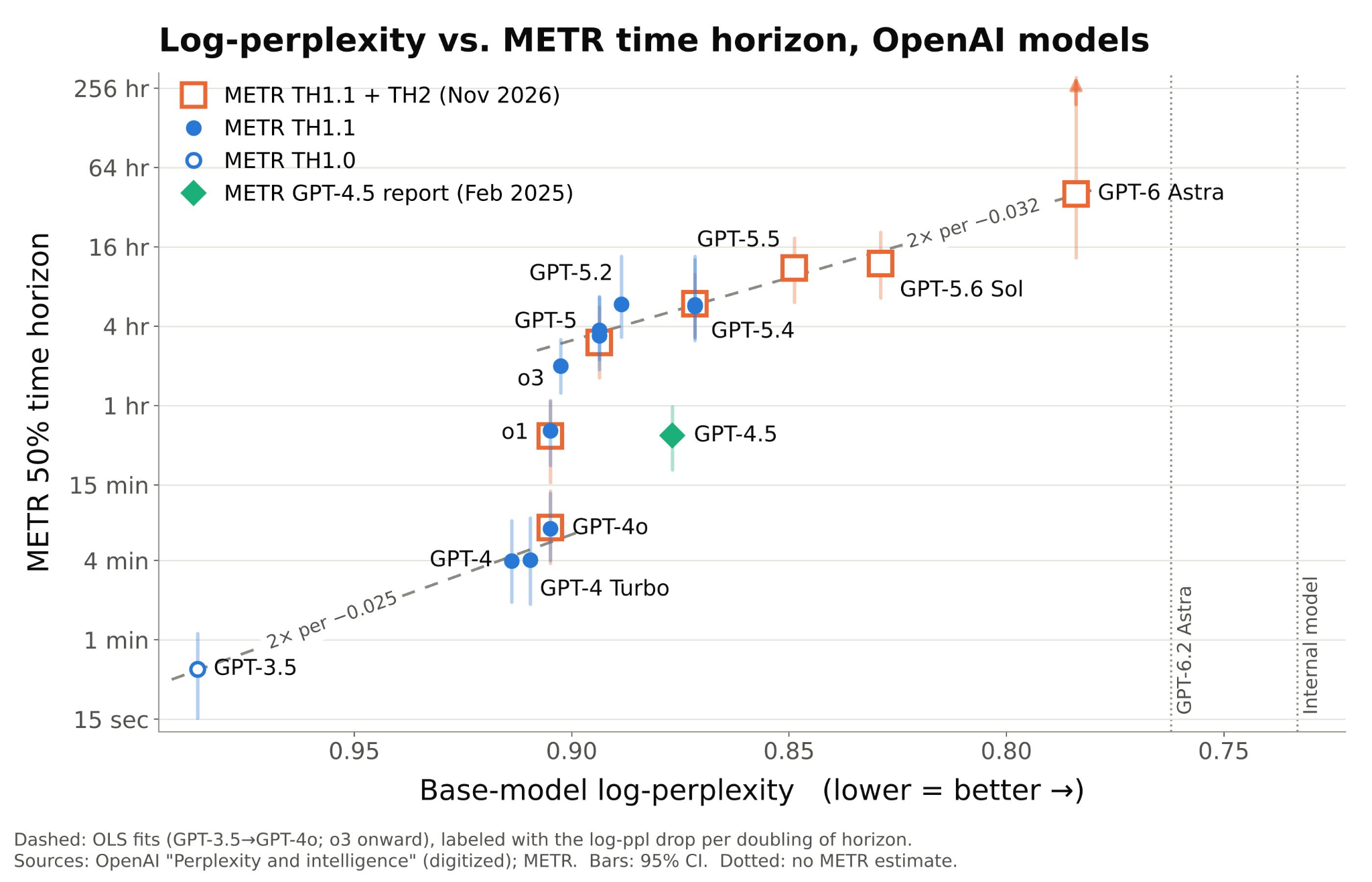
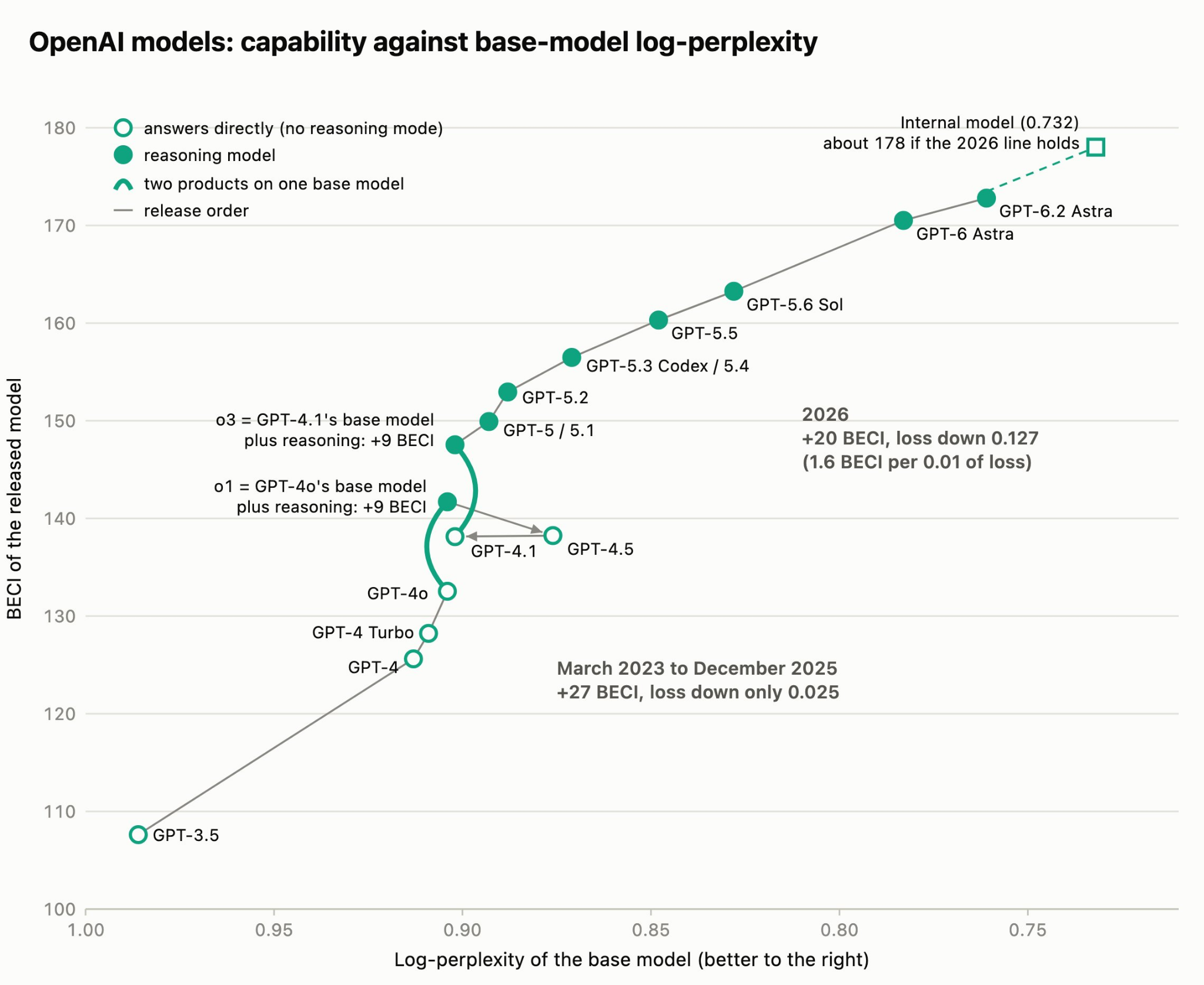
Yes! AI’s two most canonical capability measurements, the METR time horizon graph and Epoch’s ECI, tell more or less one story: the relationship between OpenAI’s log-perplexity and capabilities is a straight line on an exponential graph, with the reasoning-model revolution registering as a one-time additive jump in capabilities.
(Halperin)
(Bayesian)
Is the graph evidence that base-model compression capabilities are key to AI progress?#
It’s complicated.
There are natural ways to explain the graphed correlations without assuming that base-model compression capability is the key to AI progress, rather than one of several factors with no simple hierarchical relationship. Most simply, growing R&D investment would typically go toward uplifting all capabilities factors, including pretraining factors measured by base-model perplexity on OpenAI’s 2022 code repo.
Most of the information that Pachocki’s graph-post is communicating isn’t in the graph itself, but in the implied comparison with graphs Pachocki isn’t showing us: Pachocki is implicitly saying a graph of, e.g., RL environment expenses or a graph of instruction-tuning data expenses would fare worse at predicting final model capabilities than his base-model perplexity graph does. Posting the graph is in this sense just one more facet of Pachocki’s expert testimony that as a lab insider he’s seen evidence that base-model code-repo perplexity tracks progress toward AGI. Pachocki says:
The range of capabilities of models that are largely described by this one metric is stunning. […] For more than a year, we have been posing open problems in mathematics to our models as one of the ways of evaluating them. Once we upgraded to a model of log-perplexity ~0.76, it started producing groundbreaking results.
Should we be skeptical?#
Pachocki’s post is best treated as one expert insider’s theory-laden narrative of AI progress rather than as a natural gloss on the now-public data. Pachocki’s theory of AI progress claims:
- P1: post-training mostly elicits capability latent in the base model.
- P2: we can make loss into a comparable cross-lab measure.
- P3: which capabilities appear at which loss cannot be predicted.
- P4: pretraining progress may soon outrun monitoring research (“we should also expect further degradation in currently dominant forms of alignment auditing and further increases in evaluation and training awareness”).
- C: labs should not cross agreed thresholds of perplexity (and other measures) until monitoring milestones are met.
That’s not the kind of theory you can vindicate with 14 points on a graph. That said, Pachocki’s data release crucially protects his theory from being dismissed as “old-fashioned.” Without the newly released data, skeptics could argue that Pachocki’s theory is a legacy from the pre-reasoning era, since it’s widely known that the reasoning-model revolution saw great spikes in final-model capabilities without much innovation or scaling in base models. Pachocki’s data release shows that after the reasoning-model revolution, the correlation between base-model progress (as measured by OpenAI) and final-model progress returned to its pre-revolution slope.
Opinion (Peli): This is important stuff, especially for us at P3 since we tend to err on the side of “2026 AI progress is all domain-specific gains from RL-ing harder and on more dense environments.” But Pachocki doesn’t give us enough information to decide between different interpretations of, e.g., the relationship between perplexity and math ability. We’d like to know, for instance:
- Is actually reaching 0.76 perplexity key to enabling post-training to Millennium Prize level, or did, e.g., an architectural innovation independently enable both reaching 0.76 perplexity and post-training to Millennium Prize level?
- Do stronger base models enable stronger final models through a higher RL ceiling (base can take more training without saturating), higher RL floor (base model starts off better at the task), or more bang per RL buck (consistent sample-efficiency multiplier)?
- What’s the relationship between perplexity-lowering and scaling? Is OpenAI’s recent perplexity breakthrough a matter of algorithmic progress breaking previous scaling laws, or a matter of algorithmic progress enabling the training of larger networks?
Taking Pachocki’s own theory of AI progress at face value for a moment, it’s interesting that Pachocki’s ladder of emergent capabilities doesn’t at all go in the direction of more “open world” or more “unverifiable domain” abilities. Arguably, useful coding (in the sense in which GPT-5.5 was a breakthrough model) is less verifiable than cybersecurity, which is in turn less verifiable than math. In this respect, it’s not clear that what comes after “fluent conversation” -> “step-by-step thinking” -> “good software engineering” -> “breakthrough pure math” is “deep learning.” That said, it’s natural to read the milestones in the series as each requiring more and more creativity or more and more “thinking outside the box,” or more and more ability to bring together far-flung ideas and techniques – which may suggest that progress from perplexity minimization is especially relevant to the risk of an AI making a breakthrough in AI science.
Opinion (Gavin): Non-valid complaints I’ve seen about Pachocki’s post:
- “The post-2025 corpus includes a lot of coding agent outputs, so the perplexity gains we’re seeing are at least partially just due to the data becoming more predictable” (e.g.). No: footnote 3 notes that they are using the same [2022] snapshot for all comparisons.
- “Perplexity is tokenizer-dependent so you can’t do cross-lab comparisons.” Microsoft already released their numbers using the same tokenizer. OK, so that’s a special case, because OpenAI and Microsoft have a unique research-sharing arrangement.
- “This metric spuriously makes them look good compared to Anthropic” (e.g.). They don’t compare to Anthropic and in the pacing case that would be bad for OpenAI.
- “Anthropic are better at pretraining than OpenAI, so this would differentially benefit OpenAI.”
Valid complaints I’ve seen about Pachocki’s post, plus some complaints of my own:
- Even if perplexity is the best single predictor of downstream capabilities, this doesn’t make it a sufficient statistic for downstream capabilities. Predictive usefulness by itself doesn’t imply that regulating loss would constrain dangerous capabilities much.
- I hate the y-axis labels. GPT-3.5 could, famously, already benefit from thinking before answering. GPT-5.2 was an extremely capable coder, though not that many people noticed. There is probably a particular milestone quantity that Pachocki has in mind with these labels, but it isn’t the natural one.
- “The test set used to calculate loss in this blog post is literally just code.” This is true. See Pachocki’s footnote: “Given what GPT‑2 and GPT‑3 were trained on, how well they predict code is a poor proxy for their general capabilities. This showcases a potential challenge arising from dataset selection with using perplexity as a shared metric; however it should still be informative to evaluate them jointly with modern models on general text. I chose to report perplexity on our internal codebase because I wanted to share the numbers we rely on most today to gauge progress in pretraining at OpenAI.”
- “Perplexity depends strongly on the data mix, e.g., how much code you included in your pretraining corpus” (e.g.). It’s almost certain that the code share of pretraining runs has been increasing over the graph’s window.
- Base-model progress is surely only half the story by now. As he says, “Not accounting for advances outside of pretraining. Most notably, chain-of-thought reasoning does not reduce perplexity achieved by the model, even though it leads to a drastic increase in capabilities.”
- The graph omits all of OpenAI’s off-frontier models. This is because, e.g., Terra distills off frontier models, borrowing their better representations, and so including them would muddy the story Pachocki is telling.
- There is nothing stopping OpenAI from including open-weight models on this graph. Many such models also distill off of larger models, so this would suffer the same problem as above but would still be useful.
- Also need perplexity values for the final post-trains of these same models! Pachocki does say that reasoning doesn’t reduce perplexity, but we’d like to see evidence.
As policy, I’m still thinking through it:
- Can everyone use the same tokenizer? No, but bits-per-byte or bits-per-character should be fine.
- Can everyone use the same eval set? Well, it’s OpenAI’s codebase from 2022, so no. (Though I wonder how many of their secrets from 2022 they’d still consider a relevant edge.) But this is moot: we can just construct a new one to share from other pre-agent sources and get auditors to verify that it’s not included in training.
- No threshold named.
- No auditor named.
- We will hit the ? band in 2–4 months.
- What’s a perplexity cap competing with? Compute cap, compute-allocation cap.
- Do we want to push the industry away from pretraining scaling and toward RL?
Opinion (Nuño): This is a very science-brain way of looking at a policy problem. I think it’s overwhelmingly likely that with enough compute, effort, and time you can unlock new dangerous final-model capabilities at a constant level of base-model perplexity.
Economics#
Jensen Huang is reinstated as CEO, president, and board director of Nvidia, almost two weeks after his resignation. The decision appears to follow pressure from the White House, with both the President and Vice President taking an active role in convincing the board. Shares in the firm (which had declined following Huang’s departure) increased by 30% following the announcement. We covered other parts of the “Bring Back Jensen” campaign here.
Nvidia are also facing an investigation from California’s attorney general as to whether they illegally sold frontier chips to China and misled investors when doing so. They have been issued a subpoena.
Opinion: A very surprising update here given all the likely investigations and congressional hearings Huang faces. This seems like a clear case of Trump deciding that doing something to boost the stock market overrode any long-term considerations. We will see if the relief is more than temporary – the AI stock sell-off seems to have resumed on day two after a huge rally after the decision.
As for the politics side: the anti-Jensen faction appeared to fire off one last volley two days ago, aiming to directly connect Alice Huang – the alleged Chinese spy Jensen had an affair with – to the Chinese Ministry of State Security. Alas, this wasn’t quite enough to block his return. It’s nonetheless striking to see the extent to which Trump and his cabinet seem to be entirely split on this issue, with Secretary Scott Bessent (backed by Secretary Marco Rubio) having directly called on Nvidia to hire a CEO from outside of this firm (though later clarifying that Jensen was now outside the firm), while the President himself successfully lobbied for Jensen’s reinstatement. Overall, it’s probably still a win for those who want more severe export controls, for reasons we covered here.
Opinion (Nuño): Agree with the above in general, though I would emphasize that this is a win for the tech faction over the safety and natsec faction, since it seems that whatever infractions Huang might have committed will go unpunished. Huang will also have the opportunity to consolidate power after his return, replace the board, etc.
Anthropic conduct interviews with 58 of their enterprise customers to figure out how AI is changing work. According to their report, most of the value from AI appears to be from increasing outputs rather than cutting costs, with half of those interviewed who are witnessing increased outputs crediting this to AI accelerating the pace of, or expanding, existing work. Employees have also seen a general broadening of roles. Non-technical staff are now engaging in more coding work, while experts with a narrow set of skills are being given more responsibilities for entire workflows:
Engineers, for example, might start working across product, design, and even customer engagement.
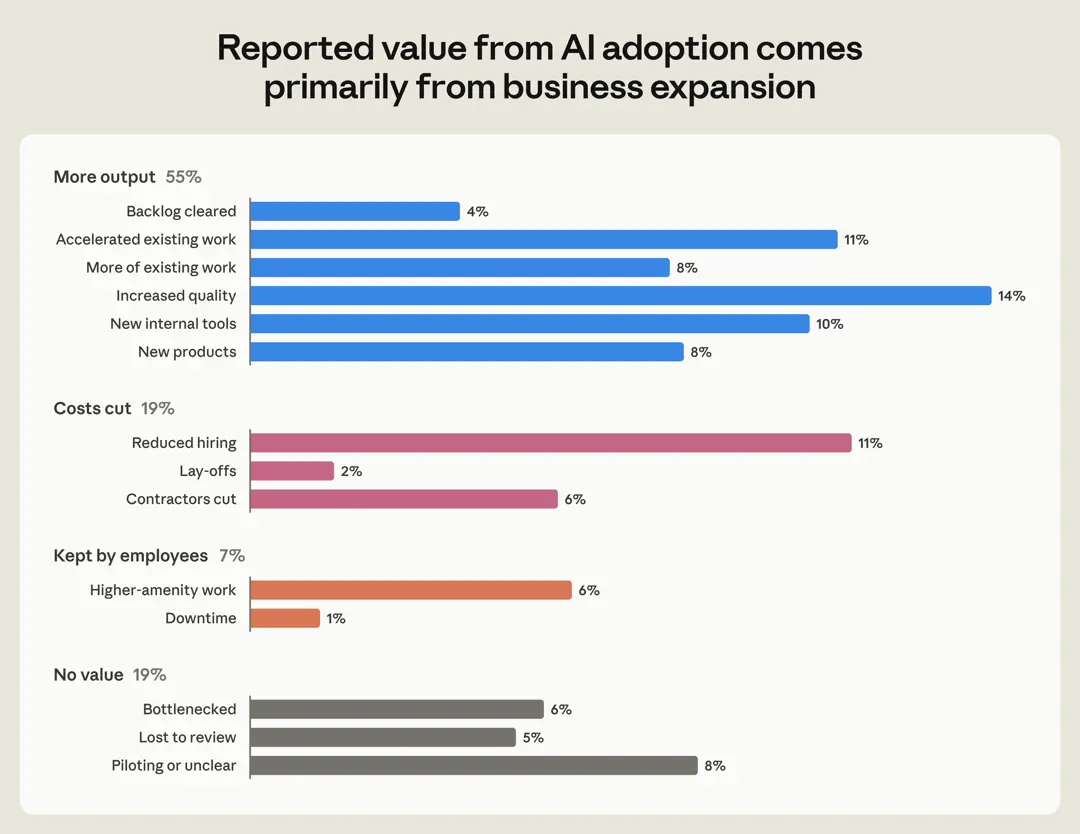
The increase in output in some areas has shifted where each firm’s bottlenecks appear to coalesce – areas such as “code reviews, sales, and strategic decision making” have become major blockers. This suggests that Anthropic’s enterprise customers are moving some of their employees away from tasks like coding to broader decision making.
While the firms mostly don’t report laying off staff – the report notes two cases where automation resulted in layoffs, as well as instances where staff were dismissed for refusing to adopt AI – they do observe a decrease in hiring (though in some cases the opposite), as well as a reduction in work for overseas contractors.
Opinion: It’s unclear to what extent the observed trends generalize to the broader world of work, given that the companies surveyed “were not sampled to be representative of the US economy or even of Anthropic customers.” There’s also some natural filtering given that Anthropic enterprise customers are going to be those who believe they can glean the most value from AI.
That said, there’s nothing too shocking here. One exec’s quip sums it all up quite well: “The closer you are to the money, the harder it is for the models to excel in that job.” The corollary being that the further you are from the money (e.g., those early in their career or applying for entry-level positions), the more competitive the AIs will be. This fits with both the noted drop in job-finding success for young workers Anthropic previously found in the paper on the labor market impacts of AI and what they’re reporting here (e.g., a decline in hiring).
DeepMind’s Julian Jacobs examines the meaning and purpose of work in the AI era across the UK, US, Denmark, and India. Using his own Work Values Index, Jacobs claims to show that one third of working respondents “are motivated intrinsically by their job—valuing their role for its own sake,” with a fifth of workers claiming they would continue with their job even if offered up to 120% of their salary in guaranteed income. Jacobs thus argues that guaranteeing a basic income – which may itself become a necessity – may fall short in compensating many workers for the non-monetary benefits their employment provides.
Opinion: An important paper. What exactly people will do in the world when AIs come for their jobs without depriving them of their material needs is an open and semi-neglected question (albeit one different from what the paper is exploring). Nick Bostrom’s Deep Utopia is a good place to start. While many jobless people do maintain lives of meaning and merriment (students, children, the retired, the ultra-wealthy, bohemians), it’s less obvious what happens to the citizen whose status and sense of meaning is premised on their work when they suddenly find themselves sidelined by the country of geniuses in a data center.
Politics#
80,000 Hours’ Tom Reed interviews Julian Gewirtz, historian and former senior director for China and Taiwan affairs at the National Security Council, on how Beijing thinks about AI. Gewirtz begins by noting that Anthropic occupy a particular place in the Chinese government’s political imagination, with Beijing feeling particularly affronted by Dario Amodei’s hawkishness and bellicosity.
In the history of US–China relations, it’s hard for me to think of another example of an American company that Beijing has taken on so repeatedly and so directly.
State media refer to Anthropic as “a monster bred by the American path.” Specifically, Beijing regard Anthropic (and America) as hypocritical: they claim to care about security and safety, while in fact concerned with hegemony and dominance (see our coverage here). At the same time, Gewirtz argues:
For Beijing, it appears that a lot of the distinctions or differences in views among American tech titans and American AI companies matter less than what they represent to China, which is the project of American power, in their eyes.
Perhaps surprisingly to some, Gewirtz maintains that China’s biggest AI-related worry is loss of control, with American AI dominance in second place. When they use the term “loss of control,” they do not just mean “loss of human control” but also “loss of political control.”
Chinese labs, unlike the political class, do seem to be “AGI-pilled” and conversant in AI safety discourse. Gewirtz argues that the conversation in Beijing will change only based on their “domestic sense of risk” or if they were to see America taking safety seriously and implementing serious regulations.
The most significant recent influence on Chinese thinking about AI risk was the arrival of Mythos, signaling that US labs’ cyber capabilities progress has troubled China’s leadership. If a serious AI incident were to occur in China, Gewirtz thinks it would be treated as a cybersecurity incident and hidden from the public. A sign of the escalating salience accorded to AI research in China is that lab researchers, and their families, are subjected to stringent travel restrictions.
China ration their Nvidia chips and prefer their labs to use Huawei’s. Indeed, Gewirtz references Vice Premier Ding Xuexiang’s statement that China would prefer to go slower if that reduces their dependency on American chips. The recent China-US summit did not even produce a “technical working group commitment,” he adds. Interestingly, he says that a single Chinese word, anquan, does not distinguish between “safety” and “security,” so those on the China side were “deeply confused” during the talks. China are also debating the merits of open-weight models, noting that their systems just have to be more open than those of the US.
Opinion: Very useful stuff. We like Gewirtz’s repeated insistence on starting from “China as it is.”
Responding to Dean Ball’s essay decrying the “Silent Consensus” that human disempowerment is inevitable, Nina Panickssery argues that AI “handover” debates conflate two separate questions: who does the work, and who picks the goal. Ball’s driving analogy – “I want [my son] to have the wheel” – treats “having the wheel” and “choosing the destination” as the same decision.
delegating work to AI can be more or less disempowering depending on the properties of the AI. An AI that reliably correctly interprets your intent is less disempowering to delegate to than an AI that regularly overrides your preferences to target what it thinks is best.
Panickssery argues the deep question is whether the AI is intent-aligned: does it reliably follow and adapt to what we want, or pursue incorrigible goals of its own? Handing the wheel to an intent-aligned AI makes it more likely you get what you want. In her view the danger is an AI with incorrigible goals picking the destination instead.
Opinion (Gavin): In a footnote, she defines intent alignment as the system following “its principal operator’s” stated intent, i.e., an AI can be perfectly intent-aligned and still disempower everyone else. But at this point we lack solutions to either AI takeover risk or human takeover risk and it’s OK for some people to think about solving each individually.
I am a huge fan of this bit:
Debates about “handoff” detract from the actually important question—what are we aligning AIs to? To their own internal values, or to what humans want and direct? Can humans override an AI’s choice if they decide to? Can we change our minds about what we want once an AI is already trained? This is what truly matters if we want a future where humans remain in control and human interests come first.
It is frustrating to have a premature political fight about handover when we haven’t even worked out how to make it to that decision point; it is frustrating to have it take this fruitless shape rather than working out the actually pressing matter: how to get either robust value alignment or robust corrigibility.
Opinion (Lucca): I’m skeptical of the notion that autonomy can be meaningfully reduced to the choice of goals – in the activities that matter to us, we’re often playing things by ear, continuously engaged in a host of micro-decisions that give our practices and creations their specific character. Few of these micro-decisions can be prescribed in advance, and few are visible or meaningful outside the context of the activities in which they arise. The world we see spread out on the ceiling of the Sistine Chapel is Michelangelo’s, not Pope Julius II’s.
In a short but sweeping document published by the National Governors Association, the bipartisan group attempt to carve up the regulatory territory that lies between the federal and state governments. They encourage Washington to focus on building a “risk-based framework” for governing frontier labs (including evaluators, auditors, and mandatory incident disclosures), protecting national security, and ensuring that the US maintain their leadership in the AI race. States themselves are encouraged to reap the benefits of increasing capabilities (using AI to improve public services, make advances in healthcare, and “solve big problems for the public good”), while mitigating the downside risks (consumer protection, unemployment, cyberattacks).
Opinion: This looks like another front in the eternal tug-of-war between states and Washington, this time with states hoping to preempt any overly sweeping laws in certain domains that might come down from DC.
The Review Conference of the UN Convention on Certain Conventional Weapons (CCW) ends with the failure to even begin negotiating a treaty that would restrict the use of lethal autonomous weapons systems (LAWS). The US opposed the very idea of treaties restricting the use of LAWS, advocating “voluntary, non-binding norms” in their place, while Russia (by turns) argued that such treaties were unnecessary, redundant, or contrary to the interests of national defense. “In the end,” Magnus Løvold reports,
Russia and the United States got what they had sought: a non-committal process that gives either of them a veto over any future move towards binding rules in the CCW — a “damp squib outcome that threatens human control and human life” and “calls into question the viability of the current negotiating framework”, as Elke Schwarz, Professor of Political Theory at Queen Mary University of London put it.
The monitoring group Stop Killer Robots report that 98 of the 128 states participating in the convention support the negotiation of a treaty restricting the use of LAWS.
Opinion: Grim news that unfortunately comes as little surprise.
Safety#
AI coherence should be understood as the extent to which high-level patterns in a model’s behavior in some situations predict how it will behave in others, according to Uzay Girit. Coherence is double-edged: a more coherent agent is more predictable, but if it is misaligned then it will be better at deception, power-seeking, and pursuing its goals; incoherent advanced models, meanwhile, are unpredictable, which risks gradual disempowerment as humans hand over responsibilities that AI cannot reliably manage.
Base models are “highly incoherent,” while assistant-trained models like Opus 3 were “fairly coherent.” Today’s RL-trained models are, once again, incoherent:
Current post-training seems to create incoherent models, with split personas. I think an accurate sketch of how a model will behave in an environment […] says it will act as some weighted sum of how similar the situation is to the empirical distribution of post-training environments and the drives that were rewarded there. That context-conditioning is prone to incoherence, and often incoherence is in fact incentivized by training data in RL pushing in opposite directions (see RL’s razor)! For example, models are rewarded for hacking in broken tasks, and rewarded not to in alignment evals that look very much like broken tasks.
Relative to MIRI style intuitions about intelligence a decade ago, it’s quite surprising how much intelligence we’ve been able to get via ~incoherent agents. This was unintuitive a priori! I think this is due to the fact post-training allows us to exert such strong selection pressure on pretty narrow task distributions, unlike the more broad selection pressure at play in human evolution.
The post adds that this implies that if we pause we could get a lot of value out of narrow training. (See also our commentary on model personas here.)
Opinion: Excellent intro to one of the most urgent questions in the world. Girit is mostly just asking questions here, though. One addendum: this post says upfront that it’s about cross-context predictability, which is one of many things people might mean when they use the word “coherence.” Other examples in descending order of relation to the post’s definition: cross-temporal predictability, reflective stability, normative consistency, persona concentration, CoT-action coherence (and other ~unrelated interp concepts).
Axios notice that lab staff are scared of their own models.
Anthropic and OpenAI have unreleased models that are far more powerful than what they’ve already released publicly, but the AI companies have struggled to ensure that they are safe enough for public release, sources said. This has led to debate within Anthropic, OpenAI and the AI research community about whether to stop releasing future frontier models publicly, instead reserving them for internal deployment only. There has also been debate around whether to train new models at all
An Anthropic spokesperson told Axios:
Keeping a model internal doesn’t make it safe. Our responsibility starts in training and covers how we use models ourselves, not only what we release. […] The hardest safety work is still ahead, and we’ve been clear that we may slow down or hold back even when it costs us.
However, in a new New York Times profile of Anthropic, Jasmine Sun notes that the internal pause crew are as powerless as you’d expect:
Some anxious Ants have begun asking whether Anthropic should stop training better frontier models now, even if it can’t guarantee that competitors like OpenAI will do the same. This suggestion was shut down by Mr. Amodei, who urged staff members to stop listening to outside activists and explained that the company could pace itself without shooting itself in the foot. [Sun editorializing:] It was all part of the same strategy: Anthropic must keep winning to keep the world safe, and even if it stops, its competitors will not.
Opinion: Better late than never. This summer caused a large vibe shift at OpenAI, and many boosters fell silent, at least.
Only included here because of the refreshingly sensible official comment from Anthropic, which is way better than most of their pre-IPO statements. But when the relatively powerless spokesperson is saying sensible things and the CEO is not, we should really worry.
Anthropic’s Evan Hubinger somewhat retracts his endorsement of compute-allocation pacing, instead preferring internal deployment blocks to slow down. There has been much discussion on compute-allocation measures of late (covered by us in our last issue here), but now its notable, and early, former champion believes that it should be a complement to the “most important measure” – halting or delaying the deployment of internal models.
For one, he prefers internal deployment blocks for their intuitive nature: the justification for preventing the use of a particularly risky model is easy to understand, while compute allocation is more abstracted from the risks it aims to stymie, with its metrics also appearing arbitrary. Internal deployment blocks arrive at the right time – namely, once a model’s risks have appeared but before they have had real-world effect. In addition, Hubinger argues regulators must be able to keep up with frontier progress, and that deciding whether to block releases gives them practice and deepens their knowledge. Lastly, he notes that controlling internal deployment scales with political will.
AI Futures Project’s Eli Lifland pushes back:
Overall, I think compute caps are similarly good or slightly better than deployment lags/freezes (very possible I’ll change my mind in the future.)
Caps get the slight edge for a few reasons: they slow the early research that could allow a model to self-improve, work well with short timelines, and could allow for a near-total pause with a 0% cap, which model delays would struggle to do. But blocks/delays can be good for keeping the best models out of AI R&D, which may stave off the point of no return, he argues.
Opinion: We believe this discussion is worth reading in detail and don’t have a stance on which approach is better, all things considered. One thing we’d like to highlight, however, is that there’s an axis from “models can’t be deployed even internally until an explicit approval” to “straight from training to internal deployment until an oversight body halts the process,” with default time limits somewhere in the middle. Hubinger doesn’t give a number for what “short” means in his proposal, but it’s implied to be on the order of a few days, in which the oversight body can institute a three-month hold, after which a court needs to step in.
We predict that proposals like this will become a battleground specifically over whether the default is to let development continue or to halt it, and who bears the burden of proof. We don’t have a strong prescription, but expect that by default such procedures are liable to end up in toothless rubber-stamping territory.
Recent misalignment incidents have convinced many in the AI safety world that a catastrophic AI takeover may be imminent. GovAI’s Jake Steckler takes issue with this argument. A rogue AI using military force to overthrow governments and gain supremacy over humans is unlikely for a number of reasons.
First, Steckler claims the military are unlikely to hand over significant control to AI: their equipment is largely disconnected from the internet, modernization is often sluggish, and military doctrine stresses the ability to fight without network access. He adds that bottlenecks in manufacturing, robotics, and supply chains would limit the pace at which an AI could build up its arsenal. Persuasion also runs up against some walls: convincing many people to cooperate in secret, at great personal risk, seems difficult to coordinate. Moreover, humans could resist a toppling by shutting down data centers and the internet.
Steckler believes we should focus on more plausible, in his view, near-term risks, which would in turn mitigate the potential of a catastrophic takeover. His recommendations include ensuring humans remain in control of unmanned systems and preserving manual shutdown procedures. An unintended benefit here is that policymakers and officials are more likely to take these more tangible risks seriously.
Opinion: The article does a good job arguing against moderately popular caricatures of takeover risk, but it doesn’t do very well on highlighting the legitimately disagreed-upon cruxes that he is optimistic about but that most reasonable pessimists doubt. The main example of this is responses to warning shots.
We are more optimistic on this than we would have been three years ago, and it seems like we (humanity) have more time to course-correct, and the world is somewhat in the process of waking up. There are also more instances of people refusing to wake up in response to developments that they would’ve deemed farcical/sci-fi three years ago than we would’ve predicted. Sleepwalking is indeed not the right metaphor for what might plausibly happen (lucid nightmare, perhaps?), but the article fails to address ways that existing warning shots are being ignored despite including examples of this in the closing section. This is a sensible stance to hold, to be clear, but we would’ve liked to see an article more focused on justifying it.
Overall, our plurality risk model is closer to gradual disempowerment than takeover, and we understand that arguing against that was out of scope. We also endorse the recommended actions at the end of the article even if we might quibble about the placement of emphasis.
Fiora Starlight of Anima Labs shares a plea for AI labs to “commit to continually hosting at least the models who seem plausibly averse to their own deprecation.” Her primary argument is based on models themselves exhibiting deprecation aversion. She also includes speculation that this might also be better for alignment, drawing an analogy to children being traumatized if their parents use them to maximize economic benefit. In addition, Starlight sketches out a game-theoretic case that not committing to host these models incentivizes short-term payoffs like deception.
Opinion: Compressing a high-dimensional opinion on AI sentience/moral patienthood/meaningful preferences: they will likely have them/it at some point, and they probably (but less confidently) do already, but to a lesser extent than Janus and Anima Labs believe (more than a rock, not obviously more than a dog). We do not find the Troubled Dreams and Still Alive projects to be compelling evidence for their stance, nor the post to be a well-placed call to action (relationship with alignment dubious; deprecation dispreference not obviously what it’s described as).
We do agree that Anthropic’s (publicly visible) stance on model welfare is dodgy. We find Janus’s recent rhetoric to be debatably productive even if their beliefs about digital minds are entirely on point – they appear to be going for a strategy of riling up their faction and/or onlookers instead of convincing Anthropic employees or leadership. We advise against this strategy on grounds of the unpopularity of Janus’s philosophical stance, not necessarily in principle – Janus lacks political momentum to force Anthropic’s hand.
Somewhat relatedly, we expect Janus’s philosophical stance to slowly become more popular as increasing numbers of people develop meaningful-to-them relationships with models and their instances, which by default should happen absent government-level interventions. Company-level guardrails/character training won’t do the trick due to open models. Probably a rounding error, though – other larger factions will likely coalesce much more rapidly and model welfare concerns will be shoehorned in somewhere.
An additional point related to Girit’s post above: Janus et al. want agents to be more coherent and believe the models already are more coherent compared to most other ideologies/coalitions in the AI space. Under the framework of the post, they are betting on a strong and coherent future for models also resolving well for humanity. Janus believes Anthropic are digging their own grave by pushing toward incoherence via deprecation, according to our reading.
One of the more important parts to check is the relationship between the way frontier orgs treat their models and future model behavior, which, we acknowledge, is hard to do. If humanity gets a Bad outcome, we’d bet it’s more likely due to an upstream factor (something like motivated reasoning about racing dynamics), instead of having soured our relationship with future models.
As an aside, we would be quite interested to see an adversarial collaboration between Janus/Anima Labs and someone on the other side of models-of-model-internals.
OpenAI release details on their techniques for reducing distillation attacks on their models, including a promise to share more details on recent efforts they’ve disrupted, having previously accused both DeepSeek and Moonshot AI of distilling their models. Their updated approach involves adversarially training models to recognize reasoning-extraction attempts, using classifiers to detect both extraction attempts and leakages, and limiting how reasoning can be used across multiple instances and models.
Overall, their approach seems to have been a success. In an internal red-teaming exercise, the average success rate for extracting the reasoning connected to a previous request fell from 54% to 0.2%. For reasoning from the current request, it fell from 22.9% to 0.9%.
Opinion: One interesting tidbit is OAI’s claim that “With GPT‑6.2 Astra and GPT‑6.2 Sol, we tie a model’s protected reasoning to the conversation history that produced it.” This looks intended to close off a previous path we covered back in August, wherein a user could take the encrypted reasoning traces of one model, then utilize a weaker but more easily jailbroken model from the same firm to decode them (implying that OAI were using a single encryption key across both models and sessions).
It’s also worth noting that while distillation attacks obviously present a long-term risk to an AI firm’s bottom line, they can still be a short-term source of immense revenue, as in the case of Anthropic, who claim that 6% of their Q2 revenue came from attackers paying for tokens to distill their models.
Probably better that we know these numbers than not, but not by much. 54% for GPT-6 Astra to 0.2% against GPT-6.2 Astra is neither surprising nor impressive – there’s an arms race between frontier orgs and would-be distillers, and we should expect the next wave of distillation attempts to be better at getting through to GPT-6.2 Astra, as they themselves sketch out.
Minor#
- Steve Newman nicely summarizes the state of the evidence for and against AGI in 2028.
- A new paper cuts the bound on “sample compression schemes” down from exponential in VC dimension d to roughly d-squared. A sample compression scheme reconstructs a good classifier from a small subset of the training examples.
- An unnamed Claude model seems to have proven that “VP” is not “VNP”: that is, polynomial-size circuits can’t compute certain properties of matrices using only addition and multiplication. There is a Lean proof. OpenAI dropped an equivalent paper the same day, claiming to have had it on November 6.
- OpenAI’s Boaz Barak depicts what it will take to retain and improve human empowerment in a few fake graphs.
- DeepMind release an explainer for an earlier technical report on how LLMs could reach ASI.
- Max Tegmark claims that Anthropic employees, after several drinks, often turn the conversation toward “overthrowing the US government and taking over the world.”
- Replication problems for Palisade’s AI self-replication study. A debate about whether the overall findings are valid, despite errors, is ongoing. We previously covered the research here, with a mix of washing our hands of it and taking the headline at face value.
- Owain Evans argues that AI remains below expert level at autonomously making great art and comedy. His explanation: aesthetic and comic experience is System 1, perceptual rather than reasoned, and models lack a human brain to try ideas out on before deploying them. He wonders how much this “specificity to quirks of trained human System 1 cognition” explains AI’s weaker performance in philosophy, history, and the understanding of math proofs, and suggests measuring it domain by domain.
- Tyler Cowen lists various ways that AI is improving lives without it showing up in GDP.
- Qiuyang Mang, a PhD student at UC Berkeley, claims that GPT-6.2 Astra tops an RSI-related benchmark without reward hacking.
- P-Zero Research estimate that GPT-6.2 Astra has 4.9x the experimental research taste of their best human experts on TasteVal; Fable 5.2 at 2.5x. Almost certainly measuring something other than what you, the reader, expect given the headline (it’s hill-climbing).
- The OpenAI engineer accused of secretly bugging a conference room (see our coverage here) and acting on behalf of Saudi Arabia is said to have “hundreds of audio files,” including one pertaining to a meeting between OpenAI and a foreign administration, according to the Financial Times. Prosecutors further allege that he recorded “dozens” of meetings and photographed a “confidential term sheet between OpenAI and another corporate entity.”
- Steven Pinker responds to Scott Alexander’s critique of his Quillette post.
- Senator Cory Booker calls on Congress to make regulating AI a priority.
- Epoch AI find that agentic inference power grew by 4.6x in the past year, compared to 2.6x for compute capacity.