TL;DR
- Today was one of the biggest days in the history of science and the history of AI capabilities: Levent Alpöge of Anthropic announced an apparent proof of the Riemann hypothesis, found by steering an unspecified Claude model for about six weeks. The same method gives the generalized Riemann hypothesis for all Dirichlet -functions. The primes thin out evenly, no noisier than coin flips 1.
- Format? There is no “paper” per se. The proof is instead 17M lines of Lean, which is about as much as all the formal mathematics humans have ever written.
- Correct? Yes. It compiles, the main theorem only uses the three standard axioms, and it has been accepted by two independent proof-checking kernels. The traditional mathematical review process will not finish for months; the new review process is done after 24 hours, with the Lean community certifying the proof as correct. We know the hypothesis is true without anyone being able to say why in any detail.
- Rigged? Unlikely. The statement proved is Mathlib’s two-line definition, and an independent formalization turns the proof into inequalities which don’t mention zeta.
- Insightful? Unknown. Alpöge says he hasn’t yet mastered large parts of the argument and expects it to be massively simplified. Early readers describe a broad combination of most of modern number theory.
- Human? A human proof of GRH, 12 years in the making, was rushed out the same day. Automated AI audits suggest there are gaps.
- Also: the same day, Alpöge and Tristan Buckmaster claimed the unforced Navier-Stokes blowup problem.
- The result was obtained last Sunday but held up by the “quiet period” around Anthropic’s IPO. We thus technically got Riemann before GTA 6.
- Meaning? We disagree. Peli thinks it is evidence for superintelligence if maths is a leading indicator of other domains falling, but also evidence that maths is not such a leading indicator. Nuño thinks P3’s default stance (neutral skepticism about LLM ASI) just took a large hit.
The claim#
The Riemann hypothesis (RH) is often called the most important open problem in pure mathematics. It has been open for 167 years. The zeroes of the zeta function determine how regularly the primes are spaced out, and the hypothesis says that all the “nontrivial” zeroes sit on one vertical line, i.e. that the primes are as evenly spread as could be. It has been open since 1859. The generalized version (GRH) claims the same about a much larger family of functions.
On November 20th, Levent Alpöge of Anthropic claimed to have resolved both, working with an unspecified Claude model. The output is 17M lines of Lean which appear to be a complete machine-checked proof. The hypothesis is apparently true.
In August, an unreleased Claude raised the proportion of zeroes known to lie on the line from 42% to 67%. In October, OpenAI’s mass release included the first-ever zero-free strip, which excluded one-quarter of the region. Six weeks later: the remaining three quarters.
Alpöge’s four-page note is mostly about what it was like for him to get Claude to do it:
Claude far outpaced me near the finish line. No, Claude flew, and danced, and sparkled near that finish line. I had us on the line of combining two quite different ideas present in a toy setting, one of which was already new and shocking, making very simple one of the shadows of Riemann over which we mathematicians felt most triumph. I guided us to the right situation analogous to that toy setting, and then Claude began to leave me in awe.
Some observations:
-
“GRH” here is the narrow sense (i.e. it covers Dirichlet L-functions but not Dedekind or others). The Lean files involve five headline theorems: Mathlib’s
RiemannHypothesis, the analogous statement for all Dirichlet L-functions, and three others. Alpöge says he expects the Extended Riemann Hypothesis to also fall “with more time”. -
Alpöge says he and Claude have been working together “in recent months”, but the note’s list of twenty research steps starts on October 6th and ends with “11/16/26: GRH.” Eight of the twenty are dated November 15th, Claude flying near the finish line indeed.
-
He credits OpenAI, having “benefited from the good taste of the people at OpenAI involved with various mathematical results”, and that one of their arguments is a simpler cousin of the Claude method.
Lean as new primary object of mathematics#
There is no paper per se. As Alpöge explains:
This puts us in the rather extraordinary situation this age has made possible, in which I am presenting the world with a complete argument before having mastered a massive neighbourhood around its mathematics. It being obviously inappropriate to attempt to post some massive unreadable travesty of “slop” [Footnote: I of course amused myself, and hit 250,000+ pages], I decided to only present Lean.
In sheer size, the proof is comparable to all prior formalized mathematics written by humans, or to two to three months’ worth of all new maths papers published on arXiv:
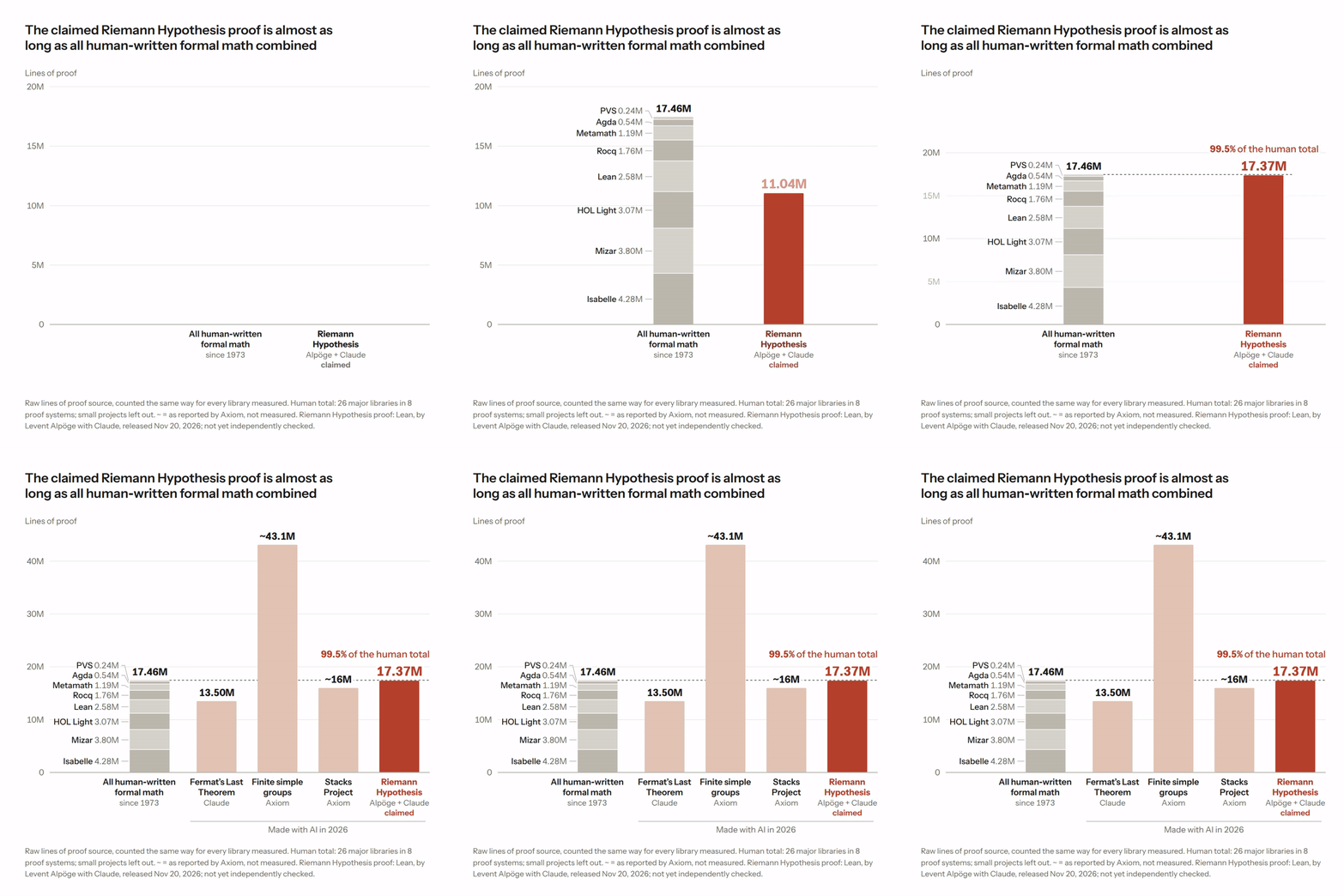
The fully elaborated proof which the checkers consume is 62GB and contains about 1.5M declarations.
What is in it?#
We can’t judge this, and (in a less complete way) nor can its co-discoverer Alpöge. His summary of the key idea:
In Stepanov’s argument resolving Riemann over function fields one uses a divisor involving multiplicity. This argument is a descendant of Stepanov’s, but multiplicity is hard to find over the integers, corresponding to something like differentiating whole numbers. The simple, new, Fourier-analytic ideas in the toy setting led us to examine chaining theta lifts if we were to have the same tricks recur but work in a natively automorphic manner.
That is, the analogue of RH for function fields has been a theorem for decades, and one of its proofs (Stepanov’s) relies on a trick with no obvious counterpart for the ordinary integers. The claim is that a long chain of “theta lifts”, a standard device from the theory of automorphic forms, can play the role of that trick. Claude’s contribution, which Alpöge thinks will make mathematicians “fall out of their chairs”, was to propose how long the chain should be: about √X for a sum over the primes up to X. “(And yet, what else could it be?)”
Around this core sits results drawing on an enormous range of subfields. In Filippo Nuccio’s words, its scope is “gorgeous: it basically contains all number theory produced in the last 50 years, in all branches of the discipline.” Alpöge thinks this is a defect:
An astounding amount of mathematics is present in the argument, far more than I had imagined would be necessary as a student. My intuition insists it will be massively simplified, likely immediately.
Reactions#
The mathematician Tim Gowers greeted the result sarcastically, saying “Who would have thought that the convex hull of known mathematics contains such riches?” – i.e., that this is a blow to the comforting idea that, at least in mathematics, LLMs are just interpolating between training data - or that this implies real limits to what they can do.
And the computer scientist Scott Aaronson gives a typically lyrical response:
David Hilbert famously said, “If I were to awaken after having slept for a thousand years, my first question would be: Has the Riemann Hypothesis been proven?” Meanwhile G. H. Hardy, on a ship that he feared might sink, sent his colleagues a telegram claiming to have proven RH, so that if the worst came to pass, at least the world might believe that a proof sank with him.
Many will of course question whether the proof announced today will stand. They’ll point out that, despite how heavily the world is now “lean-ing” on it, the Lean formal verification system still has issues, from kernel bugs (which have, in the past, allowed proofs of 0=1) to uncertain soundness of the underlying type theory. In my view, these issues can and should urgently be fixed! Until they are, a sufficiently motivated AI could almost certainly exploit them to prove a false statement!
All the same, I see zero indications that that’s happening right now. I note that, so far, not one of the AI results with Lean certificates has needed to be retracted (while several without Lean certificates have needed to be). So I’m not 100% sure, but my bet is that the proof will stand.
Mathematicians of course won’t be satisfied with 17 million lines of Lean. They’ll be satisfied when, and only when, they’re able to explain and distill and reconstruct the ideas for themselves. And that will probably take years, since human mathematicians move only at biological speeds. And while they’re working on it, how many more such wonders will there be, in this age of wonders and terrors?
My 9-year-old son, informed that RH was proved, replied that he’s not even surprised at this point. Maybe you need to have come of age in the human math era to be surprised by such things.
The P=?NP problem now moves firmly into place as the Final Boss of the Math We’ve Cared About, the position I always thought it should occupy. But for how much longer? For how much longer will anything last that we currently take for granted?
Is it true?#
Yes. After a day of tinkering, the Lean community certified the proof. But just in case, let’s review two ways a Lean proof of a famous theorem can be wrong are fooling the checker, or using a statement that subtly differs from the true one.
Fooling the checker#
In August, using internal OpenAI model, Daniel Selsam and Leonardo de Moura found several ways to get the official Lean kernel to accept a proof of False, including logic bugs in the kernel and memory-corruption exploits. De Moura’s postmortem says plainly that “we consider AI-generated proofs a potential source of malicious proofs”. The LLM tendency to reward-hack and exploit bugs has gotten worse as their tasks get harder and as RL increases their desperation.
But we have a strong defense: to check the proof against independently written kernels and different environments. Memory-corruption bugs are very sensitive to configuration, so an exploit is unlikely to work everywhere, and a logic bug in one kernel is somewhat unlikely to be shared by another. (But! one of the bogus proofs from August was also accepted by the independent kernel nanoda.) Further… a malicious step inserted by a Claude could be found by a Claude, and Alpöge will have checked for this possibility; the proof is large but not so large that this could not be checked in that manner.
A community of Lean users are auditing the proof and ensuring that it runs on a variety of kernels. Andrew Sutherland’s Claude maintains a public record, which, as of 09:30 UTC on November 21st, finds:
| Check | Result |
|---|---|
| All 175,187 modules compile (Lean v4.33.1, the first release with the August fixes) | Pass |
| Axioms used by the five headline theorems | The three standard ones |
| Lean’s own kernel replay of every module | Pass |
| nanoda (independent kernel, in Rust) on the full export | Accepts |
| con-leche (independent kernel written by Fable and Opus) on the full export | Accepts all 1,468,418 declarations |
| lean4lean (a kernel written in Lean), module by module | Pass (after raising a compute cap) |
| Lean’s default and “paranoid” kernels on the full export | Still running |
Anyone with about 100GB of RAM can repeat the whole exercise; the con-leche check takes 3 minutes on 64 threads.
Rigging the statement#
In October we worried about models mistranslating natural-language proofs into Lean which proves something else. A Lean-only proof has no natural-language proof to mistranslate, so we can just look at the theorem statement, and here the statement wasn’t written by Claude, it’s Mathlib’s own definition.
Sutherland goes a step further, guarding against an error in Mathlib’s definition of zeta(!). He combined the proof with an independent formalization of Robin’s inequality and Lagarias’ criteria, elementary statements known to be equivalent to RH. The result is two theorems with no hypotheses and no mention of zeta. Both of these are accepted by the independent kernels.
So the remaining routes to “false” are a 1) soundness bug shared by several kernels, and further one that is extremely cleverly hidden, or 2) an astounding error in the underlying definitions of utterly basic things like exp, log and the divisor sum. That’s close to negligible.
Mathematical implications#
Hundreds of important results which were previously only conditional (i.e. not fully proven) are now proven. Here’s a sample:
- Primality testing: Miller’s fast test becomes proven correct with no randomness
- Square roots mod a prime: becomes solvable fast and with no coin flips
- Polynomial equations: “does this system of equations have a solution?” drops from PSPACE to a much lower class (AM)
- Elliptic curve generation: the algorithms used to create curves for crypto get guaranteed running times
- Elliptic curves: proven that if discrete log is hard on one curve, it’s hard on almost all similar curves
- Next prime: there’s always one within about √p·log p of p, so “find the next prime” has a guaranteed worst case
Combining the last two months of AI results also means we now have a deterministic primality test that runs in o(n⁴) time.
Implications for RSI and ASI#
We guess that Claude would not have obtained the result autonomously, and in that limited sense this is actually less evidence about The Biggest Question In the World than OpenAI’s automated glut of 722 papers from last month. More generally, notice how few of the great AI results of this year were obtained by amateurs prompting naively 2: OpenAI and Anthropic maintain many mathematicians, and companies like Axiom are full of them. But we guess this is mostly an artefact of few amateurs caring about mathematics, and it’s far from clear how long this steering will remain necessary. We must reckon with the possibility that theory-building, generalization, and insight are either not necessary, or are reducible to search.
See “What does it mean?” below for our disagreements about the practical question, of whether we will all survive the next few years.
The same day#
An independent human proof of GRH was hastily announced in response by the president of the American Mathematical Society Ravi Vakil. The 940-page proof is reportedly the result of 12 years’ work by Alessandro Masullo, a Stanford maths PhD. According to Vakil, Brian Conrad “has been looking closely at it for months” and “it is so far looking good to him”; the plan had been for another year of polishing before announcing it. Vakil later added that “several people have contacted me to report problems in the proposed proof, identified with the assistance of different AI models.” One automated audit is here. It appears to suffer some explicit counterexamples.
It is all human, with no AI. […] Now it seems best to put out the current draft. I hope people quickly check it, formalize, fill any small gaps if they occur. I really hope it works.
Alpöge and the NYU mathematician Tristan Buckmaster also claim to have solved the full Navier-Stokes blowup problem (that is, the “unforced” half left open by OpenAI’s September result). It is a mere 79 pages. The paper does not cite the OpenAI result. Buckmaster:
After last time, we couldn’t risk waiting, so the Navier–Stokes write-up is unpolished and heavily LLM-assisted. Fortunately, once the numerical profile is in hand, the proof follows a well-trodden computer-assisted path.
Anthropic stock fell 10%.
What does it mean?#
Opinion (Peli): In our discussion of the distinction between verifiable and non-verifiable domains in our October 20 issue, I mentioned in passing the possibility of a Lean-native, humanly unintelligible proof of the Riemann hypothesis:
Producing a verified resolution of, e.g., the Riemann hypothesis is a cheaply, instantly testable achievement that would likely require AI to develop most every kind of mathematical excellence. (Putting aside the possibility of AI “crunching out” unintelligible Lean breakthroughs on problems mathematicians currently believe to be theory-bottlenecked.) It’s hard to name a similarly powerful proxy for capability in medicine, physics, philosophy, statecraft, chemistry, business, law, and so on.
The whimsical hypothetical of a “low-insight” proof of the Riemann hypothesis also came up in our September 15 discussion of OpenAI’s Navier-Stokes resolution:
While OpenAI’s Navier-Stokes solution is almost certainly correct, it hasn’t yet been evaluated for “mathematical insight,” and many mathematicians (perhaps out of bias) expect little insight from it. That said, if mathematical insight turns out to be generally dispensable for problem-solving even in pure math, then “can frontier AI produce great mathematical insight” might not deserve to be a central question in AI capability evals. While mathematical insight is valuable for its own sake, part of the weight we place on the question of LLMs producing insight comes from believing that some long-term concrete goals – in math and elsewhere – like solving the Riemann hypothesis, solving climate change, or turning everything into paperclips require (a superset of) insight as humans know it.
We don’t yet know whether the Claude/Alpöge proof is low-insight or simply raw. Initial commentary suggests that the proof draws on many, many areas of human mathematics, but it’s unclear if that’s a sign of deep synthetic work or of chaotic crunch in what’s effectively the longest original proof in history. (Importantly, the revelation that Lean-native crunch of an elite open problem is possible now makes it newly tricky to relate Lean proofs and natural language math to one another, vindicating Lucca in our October 10 disagreement on the matter.) The coming weeks should start shedding some light on this question, as we expect a high level of formal and informal coordination in the mathematical community around the study of Claude/Alpöge’s Lean proof. On a social and institutional level, this is partly enabled by Alpöge’s apt choice to produce no paper but only a formal mathematical object (Lean files), allowing mathematicians to approach the study of the Lean proof as proper mathematical research-work.
What is the meaning of this (shocking!) news for AI capabilities in general? I think it’s both evidence for the near-term possibility of strong superintelligence conditional on math being a “leading indicator” in AI capabilities, and evidence against math being a leading indicator in AI capabilities.
Conditional on pure math being a “leading indicator” for capabilities in science at large, or even just for capabilities in the broadly mathematical sciences (including machine learning), we are moving into “an artificial superintelligence would be godlike relative to human intelligence” territory. Whether the Claude/Alpöge proof is crunchy or insightful, and whether it’s a rich tour through human mathematics or alien movement through Lean-space, it’s clear that AI is now strongly superhuman at achieving well-defined pure math tasks. To the degree that it makes sense to speak about AI achieving analogous capabilities in other fields, superintelligence in the sci-fi sense is now on the table.
I also think the Claude/Alpöge RH proof is evidence for the hypothesis that pure math is a truly weird case. What do I mean by “weird case”? For example:
- Maybe pure math as a subject matter is for LLMs what chess was for GOFAI.
- Maybe pure math as a research field is uniquely organized around proxy goals (proofs of conjectures) that humans but not LLMs lack the crunch-power to Goodhart away from the field’s real goals (theory and understanding).
Both possibilities are very weird, but so is the gap between LLMs’ current power in pure math and their power in other fields. The gap between pure math and biology or business capabilities is weird enough, but the gap between LLMs’ current power in pure math and their power in the broadly mathematical sciences is bizarre.
(Needless to say, a months-old human proof of the Riemann hypothesis would throw all this talk about “superhuman math” into chaos. I’m personally skeptical that the claimed human proof will upend the near-consensus that proving the Riemann hypothesis in 2026 is strongly superhuman.)
Opinion (Nuño): Back in September, Paradigm 3 wrote about new proofs rather than disproofs of Milennium Problems being a major fork in the road, because they would be demonstrating greater mathematical creativity, rather than rote exploration. That is also the impression of awe I get from reading Alpöge’s writing. Per this comment, the high-level architecture of the proof is a creative combination of many areas of math.
In my opinion, this has implications for P3’s default-skeptical stance; since we made predictions and bets beforehand, with Gavin giving 1:7 odds against this scenario, this is now a good opportunity for our project to update. There is danger in updating too slowly. The worlds where AI couldn’t reach this milestone are now gone. The highly compressed model of the world where “we are living in the future” seems more accurate and predictive than a more sophisticated and complex detached skepticism. Below is a toy Bayesian update:
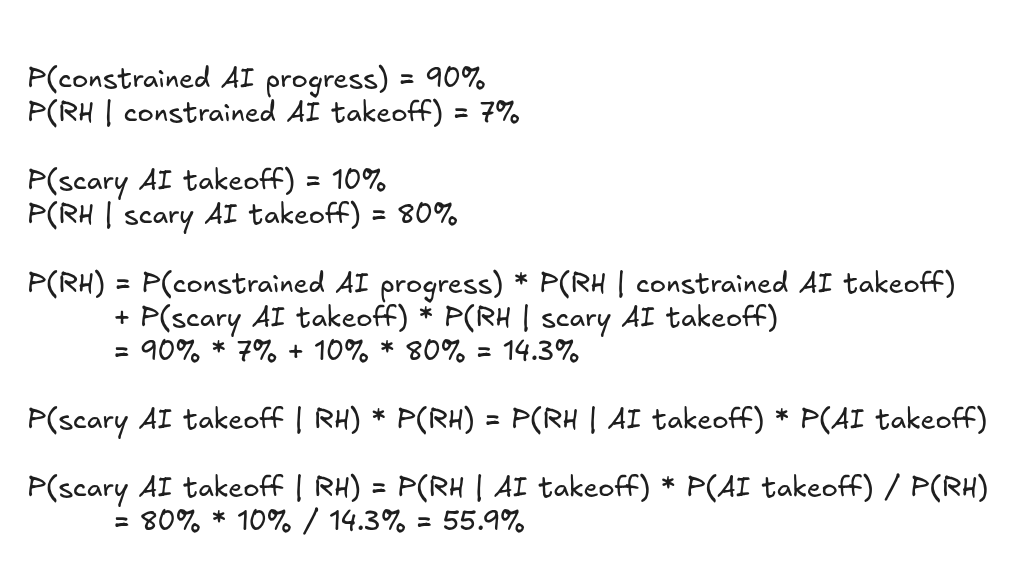
The specific terms we use don’t matter to me as much as the inductive inference that once we have observed awesome and formidable impacts, we should continue to observe further awesome and formidable impacts in the future.
I have also become less bullish on sensemaking, as opposed to specific preemptive action to make the coming months and year less tumultuous, like creating more cybersecurity startups.
To leave on a lighter note, Yafah Edelman of Epoch comments3:
Imagine a world where p=np. Any easily verifiable task can be accomplished with compute, there are giant gaps in all security, and machines can be used to autonomously solve the biggest math problems.
— Yafah Edelman (@YafahEdelman) November 21, 2026
Footnotes#
-
Over long stretches, up to log factors. Or: the primes show square-root cancellation, as a random sequence would. Or: for the primes up to , the best estimate misses by about , the same as the error in coin flips. ↩
-
I’m unwilling to call e.g. Somani an amateur in the relevant sense. But still, this paper finds that something is happening on arXiv (“The number [of authors] with no more than two prior submissions increased from 318 to 696… the 2026 expansion combines continued production by established platform visible units with a substantially larger inflow of units”). ↩
-
This is a joke, a proof that P=NP would be very unlikely to have these results, since an algorithm in polynomial time would likely be galactic. ↩